
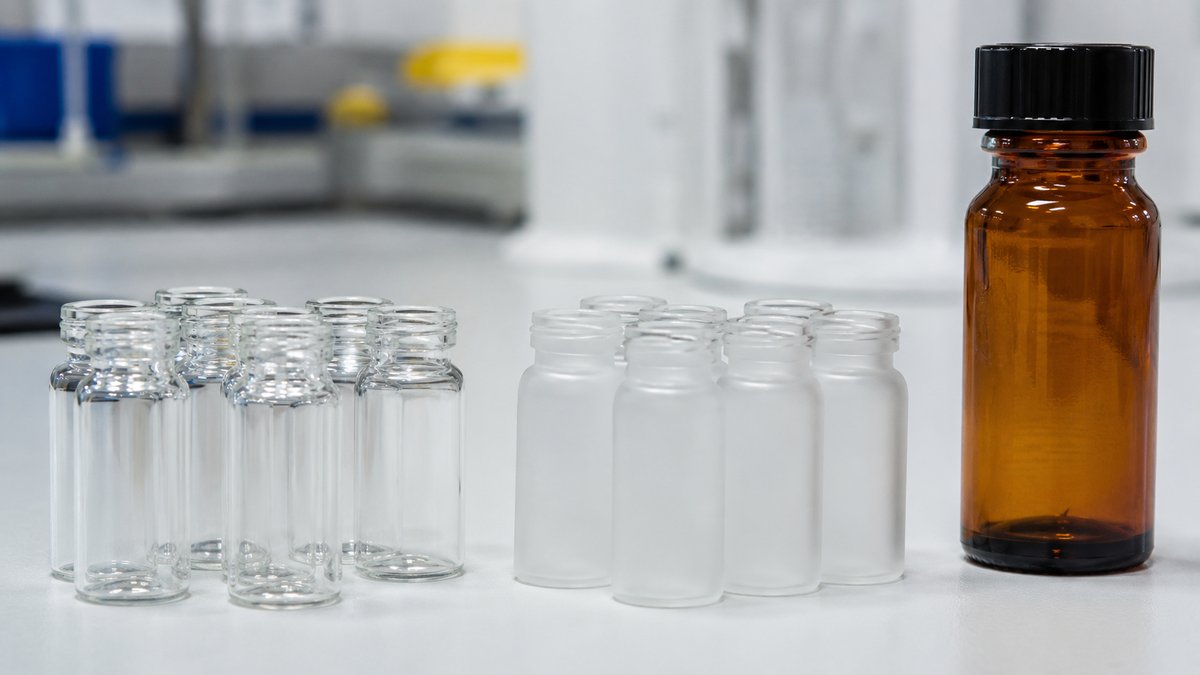
Silanized HPLC Vials vs. Standard Glass Vials: When Do You Really Need Surface Deactivation?
In HPLC, UHPLC, and LC-MS/MS analysis, poor recovery, peak tailing, and nonlinear calibration caused by active surface adsorption are common and frustrating issues. When faced with poor quantitative response or signal drift, many chromatographers first suspect column degradation or system dead volume—overlooking the most fundamental component: the surface chemistry of the autosampler vial.
This article examines the chemical nature of silanol groups on glass surfaces, explains the mechanism of silanization (deactivation), defines the application boundaries between silanized and standard glass vials, and provides practical parameter specifications and cost considerations for laboratory procurement.
1. Silanol Groups on Glass Surfaces and Analyte Adsorption Mechanisms
Laboratory-grade chromatography vials are typically manufactured from Type 1, Class A borosilicate glass. While offering excellent thermal and chemical resistance, annealed glass surfaces contain a high density of silanol groups (≡Si-OH).
Surface chemistry measurements indicate that standard glass surfaces typically exhibit a silanol density of 4.0–8.0 μmol/m² (approximately 4–5 Si-OH groups per nm²). These silanol groups adsorb analytes through three primary mechanisms:
- Cation exchange and strong hydrogen bonding (basic compounds)
Silanol groups are weakly acidic (pKa ≈ 3.5–6.8). In weakly acidic to neutral aqueous/organic solvent environments, they dissociate to form negatively charged silanolate anions (≡Si-O⁻). Analytes containing strongly polar functional groups or basic nitrogen atoms (e.g., primary, secondary, tertiary amines and pyridine rings, pKa > 7.5) are strongly retained on the vial wall via electrostatic attraction (ion exchange) or hydrogen bonding. - Lewis acid–base chelation (trace metals and multidentate ligands)
Non-deactivated glass surfaces retain trace metal oxides (Al₂O₃, Fe₂O₃, CaO). Metal cations—particularly Al³⁺ and Fe³⁺—act as Lewis acids and readily chelate polyphenols, phosphate esters, and carboxylic acid analytes, leading to active-site blocking and sample loss. - Conformational changes and hydrophobic/hydrophilic adsorption (proteins and peptides)
For biomacromolecules, the heterogeneous charge distribution on glass surfaces induces partial conformational changes, exposing internal hydrophobic cores and triggering irreversible surface denaturation and adsorption.
2. Mechanism of Silanization (Deactivation)
Silanization (deactivation) is a chemical vapor deposition (CVD) or liquid-phase reaction process in which organosilane reagents covalently bond with active silanol groups on the glass surface, converting them into highly hydrophobic, low-polarity functional groups.
The most common industrial vapor-phase deactivation reagents are dimethyldichlorosilane (DMDCS) and hexamethyldisilazane (HMDS). Using DMDCS vapor-phase deactivation as an example, the core reaction is:
2(≡Si-OH) + (CH₃)₂SiCl₂ → (≡Si-O)₂Si(CH₃)₂ + 2HCl↑
For isolated or single silanol groups, end-capping proceeds as follows:
≡Si-OH + (CH₃)₃SiCl → ≡Si-O-Si(CH₃)₃ + HCl↑
After proper high-temperature vapor-phase silanization and solvent rinsing:
– Surface silanol density decreases from > 4.0 μmol/m² to < 0.1 μmol/m² (deactivation efficiency > 98%);
– Water contact angle increases from 10°–20° (strongly hydrophilic) for standard glass to > 95° (highly hydrophobic);
– Most active proton donors and electrostatic adsorption sites are eliminated, rendering the vial wall chemically inert.
3. Five Key Scenarios Requiring Silanized Vials
Silanized vials carry a higher unit cost but are essential for data accuracy and reproducibility in the following applications:
- Trace and ultra-trace analysis (< 1 μg/mL, ppb/ppt levels)
At high concentrations (e.g., 100 μg/mL), the 5–10 ng of sample adsorbed by the vial wall has a negligible relative effect (< 0.1%). However, at ppb levels (e.g., LC-MS/MS pesticide residue screening, environmental PAH analysis), wall adsorption can account for 30%–80% of total sample mass, causing severe calibration nonlinearity or false negatives. - Strongly basic compounds and polyamine drugs (pKa > 8.5)
Tricyclic antidepressants (amitriptyline, imipramine), alkaloids, and nitrogen-containing heterocyclic drugs readily protonate in aqueous solvents. Storage in standard glass vials for over 2 hours produces measurable peak area loss (20%–60%) and peak tailing (tailing factor T > 1.8). - Low-concentration calibration standards and serial dilutions
Low-concentration calibration points (0.5, 1, 5 ppb) stored overnight in standard vials often show significant response loss due to adsorption, yielding linear regression coefficients R² < 0.995. Silanized vials substantially extend the storage stability of dilute standards. - Long autosampler sequences and overnight runs
In high-throughput sequences running 24–72 hours, samples at the end of the queue remain in vials for extended periods. Standard vials produce significant time-dependent quantitative drift (RSD > 15%), whereas silanized vials maintain response consistency throughout the run. - Polar peptides and oligonucleotides
Short peptides rich in histidine or arginine residues, as well as oligonucleotides, are readily captured by standard glass via electrostatic and hydrogen-bonding interactions. Using deactivated vials or deactivated polypropylene (PP) micro-inserts improves recovery by 20%–50%.
4. Applications Where Standard Glass Vials Are Sufficient
In most routine quality control (QC) and development testing, silanized vials are not required. Standard Type 1, Class A borosilicate glass vials perform satisfactorily under the following conditions:
- High or medium concentration analysis: Assay of active pharmaceutical ingredients (API), purity testing, or samples at concentrations > 10 μg/mL (ppm level or above).
- Nonpolar, neutral, or strongly acidic compounds: Aliphatic hydrocarbons, steroids, esters, neutral small molecules, and strong acids (electrically neutral at pH < 3, with no charge-based adsorption tendency).
- Pure organic solvent systems: Samples dissolved in 100% methanol, acetonitrile, dichloromethane, or chloroform. Solvent competition and altered dielectric constants render wall adsorption negligible.
- Immediate-injection routine samples: Short injection sequences (< 4 hours) with no prolonged storage requirements.
5. Performance Comparison
| Parameter | Standard Glass Vial (Type 1 Class A) | Silanized Vial |
|---|---|---|
| Surface silanol density | 4.0–8.0 μmol/m² | < 0.1 μmol/m² |
| Water contact angle | 10°–20° (strongly hydrophilic) | > 95° (highly hydrophobic) |
| Amitriptyline recovery at 10 ppb (24 h) | 25%–55% (significant tailing) | > 95% (symmetrical peak) |
| Calibration linearity (R², 0.5–50 ppb) | 0.985–0.992 | > 0.999 |
| Maximum temperature tolerance | 500°C | < 200°C (thermal decomposition of methylsilane layer above this) |
| Relative unit cost | 1.0× (baseline) | 2.5×–4.0× |
6. Cost Considerations and Procurement Recommendations
- Pre-deactivated single-use vials vs. in-house silanization
Although liquid silanization reagents (e.g., 5% DMDCS in toluene) are commercially available for laboratory reprocessing, in-house silanization of recycled vials is strongly discouraged. Issues include poor coating uniformity, high batch-to-batch RSD, the corrosive and toxic nature of DMDCS, and the risk of siloxane contamination in LC-MS (e.g., m/z 221, 295 fragment ions) from incomplete rinsing. We recommend purchasing commercially certified, single-use deactivated vials validated by GC/MS or LC-MS. - Matching caps and septa for deactivated performance
A silanized vial body alone is insufficient. Use high-purity PTFE/silicone septa. For trace or MS-based analysis, select double-sided PTFE-faced or pre-slit septa to prevent coring and to avoid solvent contact with non-deactivated silicone layers, which can introduce secondary adsorption or leachable impurities. - Related Resources from hplcvials.com:
- Product: 1.5mL Snap Ring Vials
- Guide: low‑adsorption vials, vial surface treatments, si…
- Guide: How does silanization compare to other surface dea…
- Guide: 8 Key Features of Glass Vials with PTFE Coated But…
Tiered procurement strategy
- Routine QC/R&D laboratories: Stock 85%–90% standard glass vials and 10%–15% silanized vials (reserved for low-concentration calibration standards and specific basic drug assays). Establish a clear vial selection SOP.
- Bioanalytical / trace pesticide / LC-MS/MS laboratories: Adopt silanized vials (or deactivated PP micro-inserts) as the standard injection configuration to eliminate adsorption-related outliers at the source.