
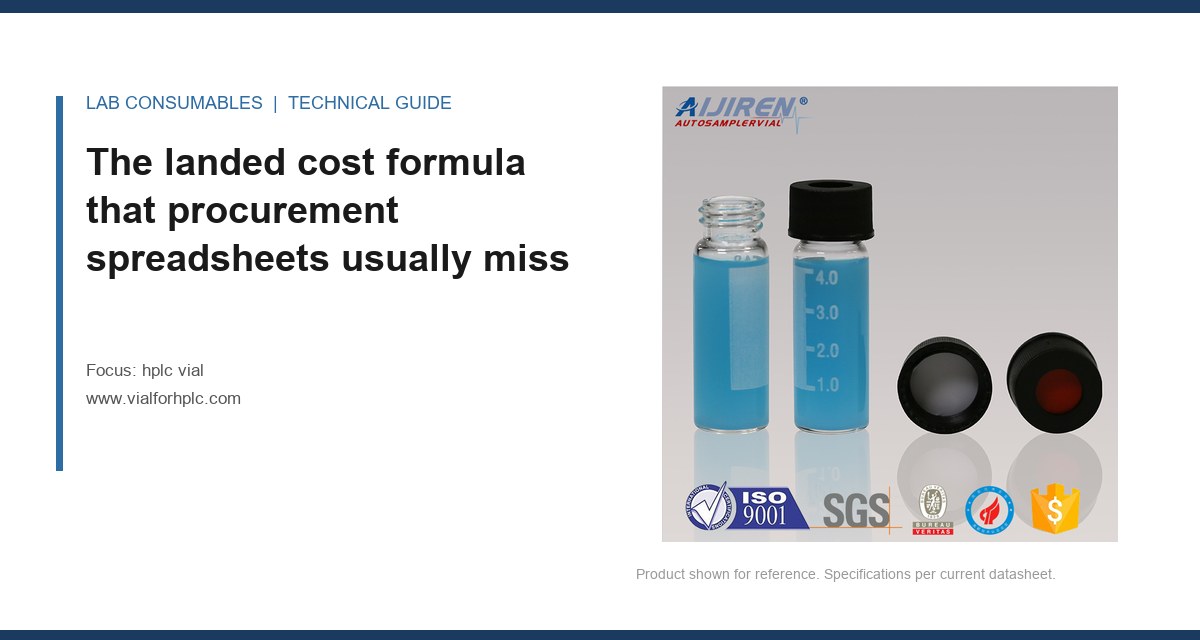
A purchasing manager at a mid-size environmental testing lab approved a quote for 10,000 9 mm screw-top HPLC vials at $0.32 per unit. Six weeks later, the finance director asked why the landed cost per usable vial came out to $0.51. The difference was not freight. It was a 3.7% autosampler failure rate traced to a septum lot that cored under a 23-gauge needle after the second puncture. That gap between invoice price and usable cost is what this article dissects. If you are running an hplc vial landed cost calculation for a procurement decision, unit price is only the first line.
Most buyers calculate landed cost as invoice price plus freight plus duty. That number is fine for warehouse valuation. It is wrong for analytical operations. The number you need is cost per usable vial, which divides total acquisition cost by the number of vials that actually produce a valid injection without a rerun, a needle replacement, or a batch reprocessing event.
Here is the formula I use when quoting a new vial source for a lab running 500 samples per day:
- Cost per usable vial = (invoice cost + freight + duty + inspection labor + storage carrying cost) / (vials purchased x usable fraction)
- Usable fraction = 1 – (failure rate from coring + failure rate from dimensional rejects + failure rate from contamination events)
The usable fraction is where most spreadsheets go blank. A vial that looks fine in the box but produces a carryover peak or a bent needle is not a usable vial. It is a cost you already paid for and will pay for again.
Freight is not a flat percentage: mode, distance, and packaging density change the math
HPLC vials are dense, fragile, and shipped in nested trays. Freight cost depends on three variables that procurement teams often collapse into one line item. First, dimensional weight. A carton of 1,000 12×32 mm vials in 100-position polypropylene trays weighs about 9 kg but occupies 0.06 cubic meters. Air carriers charge by whichever is higher, actual or volumetric weight. For this product, volumetric weight is usually 20 to 30% higher than actual weight.
Second, packaging density. Vials shipped in bulk bags instead of trays reduce volume by up to 40%, but the breakage rate rises from under 0.1% to 0.5% or more depending on the carrier. I have seen a shipment of 50,000 bulk vials arrive with a 1.8% breakage rate because the bags shifted inside the carton. That loss wiped out the entire freight savings.
Third, mode. Ocean freight from a Southeast Asian manufacturer to a U.S. East Coast port runs $0.004 to $0.008 per vial for a full container. Air freight runs $0.02 to $0.05 per vial. For a 10,000-vial order, air freight adds $200 to $500. That is real money, but it is still less than the cost of a single failed batch if a critical method is down waiting for vials.
When I calculate freight for an hplc vial landed cost calculation, I always ask for the carton dimensions and gross weight, not just the per-unit shipping quote. Two suppliers quoting the same unit price can differ by 35% on freight because one ships in trays and the other in bulk bags with a higher breakage allowance.
Duty and tariff codes: the difference between 0% and 8.5% is a classification decision
HPLC vials made of borosilicate glass fall under Harmonized System heading 7017, laboratory, hygienic or pharmaceutical glassware. The specific subheading depends on whether the vial is classified as 7017.10 (fused quartz or other fused silica) or 7017.90 (other). Most 9 mm screw-top HPLC vials are 7017.90.60 under the U.S. schedule, which carries a general duty rate of 8.5% for most favored nation countries. Some countries have free trade agreements that reduce this to 0%.
The mistake I see repeatedly is classifying vials under 7010 (carboys, bottles, flasks, jars, pots, phials, ampoules, and other containers). That heading is for general packaging, not laboratory glassware. If your customs broker uses 7010, you may pay a lower rate now and face a reclassification audit later. If they use the correct 7017 heading, you pay the right rate and avoid penalties.
Duty applies to the transaction value, which includes the invoice price plus any packing costs, selling commissions, and assists. It does not include freight and insurance if those are separately stated on the commercial invoice. Keep them separate. A supplier that rolls freight into the unit price forces you to pay duty on freight.
For a 10,000-vial order at $0.32 per unit, the invoice value is $3,200. At 8.5% duty, that is $272. At 0%, it is zero. The difference is 2.7 cents per vial. Not huge, but it compounds across a year of quarterly orders.
Inspection is not optional when a supplier changes glass source or septum lot
You cannot inspect quality into a vial. You can only detect what the supplier shipped. The question is how much inspection is enough. I use a three-tier approach based on supplier history and application risk.
For a new supplier or a new lot from an existing supplier, I pull 32 vials per 10,000 and check the following:
- Vial outer diameter at the shoulder: 11.6 mm ± 0.2 mm for a 12×32 mm vial. A 0.3 mm deviation causes the vial to bind in the autosampler tray.
- Cap thread engagement: screw the cap on and measure the torque to seat. A good 9 mm cap seats at 0.8 to 1.2 N·m. Below 0.6 N·m, the cap loosens during agitation. Above 1.5 N·m, the septum deforms and the needle drags.
- Septum puncture count: use a 23-gauge, 51 mm needle with a bevel tip and puncture the same spot at 90 degrees. A PTFE/silicone septum should survive 3 punctures without coring. A PTFE/silicone/PTFE septum should survive 5 punctures. If the septum cores on puncture 2, reject the lot.
- Glass surface pH: fill a vial with 1 mL of 18.2 MΩ·cm water, cap it, and let it sit at 40 °C for 24 hours. The pH should not shift by more than 0.3 units. A larger shift indicates surface alkali leaching from poorly annealed glass.
Inspection labor costs between $18 and $35 per hour for a lab technician. A 32-vial inspection takes about 2 hours including documentation. That is $36 to $70 per lot, or $0.004 to $0.007 per vial. Cheap compared to the cost of finding a bad lot after it is already in the autosampler queue.
One environmental lab I worked with skipped incoming inspection because the supplier had been stable for three years. The supplier switched septum material from a Japanese silicone to a lower-cost alternative without changing the part number. The first sign was a 12% increase in needle replacements over a two-week period. The lab traced it to septum coring on injection 1. The cost of the needle replacements alone was $1,800. The inspection would have cost $70.
Storage is a carrying cost, not a warehouse line item
HPLC vials are not inert in storage. The septum is a polymer laminate that ages. The glass surface adsorbs moisture and volatile organics from warehouse air. The cap liner can cold-flow under sustained compression if trays are stacked too high.
I recommend storing vials at 15 to 25 °C and 20 to 50% relative humidity. Below 15 °C, PTFE liners stiffen and the needle puncture force increases. Above 50% RH, the silicone layer absorbs moisture and can swell, changing the reseal characteristics. Above 25 °C, the PTFE/silicone bond can delaminate over time.
Storage carrying cost is typically calculated as 1.5 to 3% of inventory value per month for a temperature-controlled warehouse. For a $3,200 order held for 3 months, that is $144 to $288. The real cost is not the money. It is the shelf-life clock. A septum lot stored at 25 °C for 12 months performs differently than the same lot stored for 1 month. If you buy a year of inventory to get a volume discount, you are also buying a year of septum aging.
I have measured the puncture force on a 12-month-old PTFE/silicone septum at 25 °C versus a fresh lot. The aged septum required 18% more force to puncture with a 23-gauge needle. That translates to more needle wear, more bent needles, and more autosampler errors. The volume discount has to exceed the cost of those failures or it is not a discount.
Failure cost: the bucket that turns a $0.32 vial into a $0.51 vial
Failure cost is the one bucket that procurement spreadsheets never include because it does not show up on an invoice. It shows up in the lab’s instrument downtime log, the needle replacement order, and the rerun queue. Here is how I calculate it.
A vial that fails in the autosampler produces one of three outcomes:
- Rerun: the injection is invalid and the sample must be run again. Cost = operator time + instrument time + solvent + a new vial.
- Needle replacement: the septum cored and the needle tip is damaged or plugged. Cost = needle + downtime + calibration verification.
- Batch rejection: the failure affects multiple samples and the entire batch must be reprocessed. Cost = everything above multiplied by batch size.
For a lab running a Thermo Fisher or Agilent autosampler, a needle replacement costs $120 to $400 for the part plus 30 to 60 minutes of downtime. At a fully burdened lab rate of $150 per hour, downtime adds $75 to $150. A single coring event can cost $200 to $550.
Now apply that to a lot with a 3.7% failure rate. Out of 10,000 vials, 370 fail. If each failure costs an average of $75 in rerun labor and consumables, that is $27,750 in hidden cost. Spread across 10,000 vials, that is $2.78 per vial. The unit price was $0.32. The failure cost is 8.7 times the unit price.
That is why the hplc vial landed cost calculation must include failure cost. The invoice price is not the product. The usable injection is the product.
Worked example: from $0.32 unit price to $0.51 cost per usable vial
Here is a real calculation from a 10,000-vial order I reviewed for a contract lab running EPA 8270 semivolatile organic analysis by GC-MS. The vials were 2 mL, 12×32 mm, clear borosilicate glass, 9 mm screw cap with PTFE/silicone septum. The supplier quoted $0.32 per vial.
| Cost bucket | Calculation | Total | Per vial |
|---|---|---|---|
| Invoice | 10,000 x $0.32 | $3,200 | $0.320 |
| Freight | Air freight, 12 cartons, 156 kg volumetric | $340 | $0.034 |
| Duty | 8.5% on $3,200 invoice value | $272 | $0.027 |
| Inspection | 32-vial incoming inspection, 2 hours at $25/hr | $50 | $0.005 |
| Storage | 3 months at 2% per month on $3,200 | $192 | $0.019 |
| Subtotal | Landed cost before failures | $4,054 | $0.405 |
| Failure cost | 3.7% failure rate x 370 vials x $75 average rerun cost | $27,750 | $2.775 |
| Total usable cost | Landed cost + failure cost, divided by 9,630 usable vials | $31,804 | $3.303 |
Wait. That gives $3.30 per usable vial, not $0.51. The difference is that the $75 average rerun cost includes operator time, solvent, and instrument time. If you only count the direct consumable cost of a rerun (new vial plus solvent plus 5 minutes of operator time at $30/hr), the rerun cost drops to about $5. Then the failure cost is 370 x $5 = $1,850, and the total usable cost is $5,904 / 9,630 = $0.61 per usable vial.
The $0.51 figure from the opening scene used a rerun cost of $2.50 per failure, which is just the vial plus a small solvent allowance. The point is not the exact number. The point is that the failure cost dominates the calculation whenever the failure rate exceeds 1%. At a 0.5% failure rate, the failure cost is $250 and the usable cost is $4,304 / 9,950 = $0.43. At a 5% failure rate, the usable cost explodes.
The decision rule is simple: a 1% failure rate adds more to the cost per usable vial than a 50% price difference between two suppliers. A $0.16 vial with a 5% failure rate costs more per usable injection than a $0.32 vial with a 0.5% failure rate.
Where the failure rate comes from: lot-level variables you can measure before the order ships
You cannot measure the failure rate of a lot you have not received. But you can measure the variables that predict it. I ask suppliers for three pieces of data before I place an order:
- Glass hydrolytic class: HPLC vials should meet USP Type I borosilicate glass requirements, which means a hydrolytic resistance of Class I per USP 660. This corresponds to a maximum of 0.1 mL of 0.02 N acid consumed per 10 g of glass powder. If the supplier cannot provide this, the glass is not Type I.
- Septum puncture specification: the supplier should state the number of punctures the septum withstands at a specified needle gauge and speed before coring. For a 9 mm PTFE/silicone septum, the specification should be 3 punctures minimum at 23 gauge. For PTFE/silicone/PTFE, 5 punctures minimum.
- Dimensional tolerance certificate: the vial outer diameter, height, and thread specification should be stated with tolerances. A 12×32 mm vial should be 11.6 mm ± 0.2 mm OD and 32 mm ± 0.25 mm height. The thread should conform to GPI 9-425 or the equivalent ISO thread profile.
Suppliers that cannot provide these three data points are not cheaper. They are unmeasured. And unmeasured cost is not savings.
Two field cases where landed cost math changed the purchase decision
Case 1: The ocean freight savings that cost more than it saved. A pharmaceutical QC lab switched from a domestic supplier to an Asian manufacturer to save $0.08 per vial. The order was 50,000 vials. Ocean freight saved $1,100 versus air freight. The shipment spent 42 days in transit and sat in a non-climate-controlled warehouse for another 3 months. The septum lots aged during transit and storage. The lab measured a 22% increase in puncture force on the aged septa versus the qualification lot. Needle replacement frequency doubled. The annual needle cost increase was $4,300. The freight savings was $1,100. The lab switched back to air freight and a 30-day inventory target.
Case 2: The duty classification audit that changed the unit cost. A contract lab imported HPLC vials under HS 7010.90 for three years and paid 0% duty under a free trade agreement. A customs audit reclassified the vials under 7017.90.60 and assessed 8.5% duty retroactively for 36 months of entries. The total assessment including interest was $42,000 on $490,000 of imports. The lab’s landed cost model had used 0% duty. The actual duty was 8.5%. The per-vial cost increased by $0.027. The lab’s procurement team had to rebid three active contracts because the margin did not support the corrected landed cost.
Decision checklist for an hplc vial landed cost calculation
Before you approve a vial purchase, run this checklist. Each item has a concrete threshold. If the answer is no, the unit price is not the number you think it is.
| Check | Threshold | Action if failed |
|---|---|---|
| Supplier provides glass hydrolytic class certificate | USP Type I, Class I | Reject supplier |
| Septum puncture specification stated | 3 punctures at 23 gauge for PTFE/silicone | Request data or reject |
| Dimensional tolerance certificate | 11.6 mm ± 0.2 mm OD, 32 mm ± 0.25 mm height | Request data or reject |
| Freight quote includes carton dimensions and gross weight | Volumetric weight calculated | Request full quote |
| Duty classification confirmed in writing by broker | HS 7017.90.60 for U.S. imports | Correct before first entry |
| Incoming inspection plan in place | 32 vials per 10,000, 2-hour protocol | Write and approve protocol |
| Storage conditions specified | 15 to 25 °C, 20 to 50% RH | Confirm warehouse capability |
| Failure rate tracked by lot | Less than 1% usable-loss rate | Investigate and quarantine lot |
How to compare two suppliers on cost per usable vial, not unit price
When you have two quotes, do not compare the unit price column. Build a small table that converts both quotes to cost per usable vial using the same assumptions. Here is a comparison I ran for a lab choosing between a domestic supplier at $0.41 per vial and an Asian supplier at $0.28 per vial.
| Cost bucket | Domestic supplier | Asian supplier |
|---|---|---|
| Unit price | $0.41 | $0.28 |
| Freight (air, 10,000 vials) | $120 | $410 |
| Duty | $0 | $238 |
| Inspection | $50 | $70 |
| Storage (3 months) | $120 | $180 |
| Landed cost | $4,390 | $3,698 |
| Expected failure rate | 0.5% | 2.5% |
| Usable vials | 9,950 | 9,750 |
| Failure cost at $25 per event | $1,250 | $6,250 |
| Total cost | $5,640 | $9,948 |
| Cost per usable vial | $0.57 | $1.02 |
The Asian supplier looked 32% cheaper on unit price. It was 79% more expensive per usable vial. The difference was entirely in the failure rate assumption. If the lab had not measured the failure rate, it would have made the wrong decision and then spent a year wondering why the consumables budget was overrun.
What I tell procurement managers who only see the unit price
I tell them to stop buying vials and start buying injections. An injection is a vial that works. A vial that fails is not a vial. It is a liability that arrived in a box with an invoice attached.
The Hplc Vial selection process should start with the autosampler specification, not the catalog price. The autosampler drives the dimensional tolerance, the septum puncture requirement, and the glass surface chemistry. The price is the last variable, not the first.
When you run an hplc vial landed cost calculation, include freight, duty, inspection, storage, and failure cost. Use the same failure rate assumption for every supplier you compare. If a supplier cannot provide the data to estimate the failure rate, assume a rate that reflects the risk of an unmeasured lot. That assumption will change the ranking more than any price difference.
For labs that need a reliable source with documented lot-level data, Chromatography Consumables and Lab Vials both publish the specifications I check before placing an order. Aijiren Brand vials ship with the dimensional and septum puncture certificates that make the landed cost calculation a measurement, not a guess. For method-specific vial requirements under U.S. EPA SW-846 methods, check the method’s sample handling section before finalizing the vial and septum combination. Restek publishes technical guides that cross-reference method requirements to vial specifications, which is useful when a method change forces a vial requalification.
The decision rule is this: if you cannot calculate the failure rate, you cannot calculate the landed cost. If you cannot calculate the landed cost, you are not buying vials. You are buying risk. A 1% failure rate costs more than a 50% price difference. Run the numbers before the order, not after the autosampler starts rejecting injections.
References & further reading
Related resources from our lab consumables network:
- Hplc Vial at vialforhplc.com
- Chromatography Consumables at chromatographyconsumables.com
- Lab Vials at labvials.com
- Aijiren Brand at aijirenvials.com
External references and standards: