
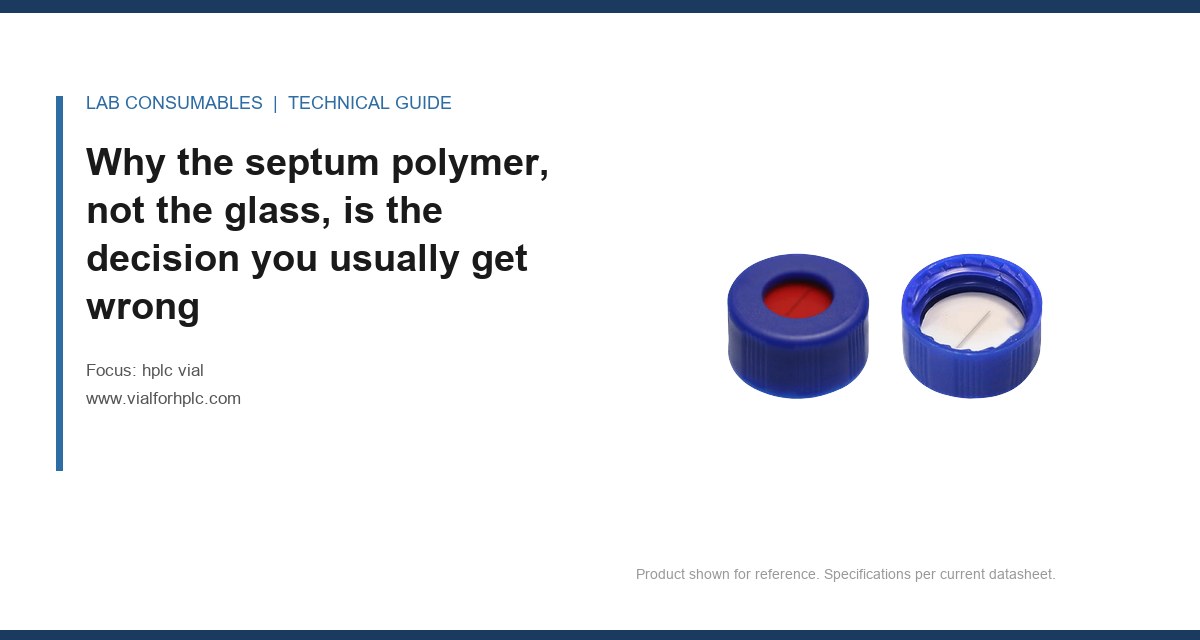
A 12 x 32 mm screw vial capped with a red PTFE/silicone septum and run on a 40 °C autosampler tray with 100% acetonitrile will lose its seal integrity faster than most labs expect. I watched a stability batch fail at day four because the silicone layer had absorbed enough acetonitrile to swell 14% by volume, and the resulting compression set let the septum lift under the needle. The injection volume drifted from 5.0 µL to 4.3 µL across the run. That is the kind of failure you only prevent by matching the polymer to the method, not by buying the cheapest cap on the shelf. This guide covers which hplc vial material to use for a given solvent and temperature, and what each wrong choice actually does to your data.
The glass body is almost always borosilicate 33 expansion or, less often, 51 expansion. Both are chemically inert enough for the solvents and pH ranges in routine HPLC. The decision that actually matters is the septum, and to a lesser extent the cap liner and the bonded seal. The septum is the only part of the vial that contacts the sample, the needle, and the headspace vapour simultaneously, and it is the part that fails first.
Four polymer families dominate the market: PTFE, silicone, EPDM, and laminate constructions (usually PTFE-faced silicone or PTFE-faced EPDM). Each has a solvent compatibility envelope, a pH window, and a temperature ceiling. Get the envelope wrong and you do not get a warning. You get a slow drift in peak area, a coring problem, or a septum that extrudes into the vial neck under torque. The right material depends on three variables: the organic modifier, the aqueous phase pH, and the autosampler tray temperature.
PTFE: the inert workhorse with a mechanical weakness
PTFE is the most chemically inert septum material in routine use. It resists almost every organic solvent, including acetonitrile, methanol, dichloromethane, tetrahydrofuran, and dimethyl sulfoxide. It handles the full pH range from 0 to 14 without hydrolysis. Its continuous service temperature runs to about 260 °C, which is well beyond any autosampler tray you will encounter.
The problem is mechanical. Pure PTFE is soft and cold-flows under compression. A pure PTFE septum will take a compression set and lose reseal force, especially after multiple punctures. In practice, pure PTFE septa are rated for roughly one to three punctures before the reseal degrades. That is fine for a single-injection standard, and unacceptable for a 96-position tray running duplicates.
The practical answer is a PTFE-faced laminate, not pure PTFE. The PTFE face contacts the sample and provides the chemical inertness. The backing layer (silicone or EPDM) provides the elastic reseal. A good PTFE/silicone laminate holds reseal through 10 to 20 punctures at 23-gauge needle gauge, depending on cap torque. That is the material most HPLC methods should default to, provided the method does not run hot or at extreme pH.
Failure mode of the wrong PTFE choice
If you use pure PTFE on a multi-injection tray, the symptom is a progressive loss of seal. The first injections look fine. By injection 15 the septum has taken a permanent set, the needle no longer reseals cleanly, and you see a slow decline in peak area with a matching rise in carryover from the previous sample. The fix is to switch to a PTFE/silicone laminate and re-torque the caps to the cap manufacturer’s spec (typically 0.5 to 0.8 N·m for a 9 mm screw cap).
Silicone: excellent reseal, poor solvent resistance
Silicone is the elastic layer in most laminates because it reseals beautifully. A 1 mm silicone septum will hold reseal through 30 or more punctures at 23 gauge. It also has a wide temperature range, from about -60 °C to 200 °C, which makes it the default for cold trays and for methods that run near ambient.
The problem is solvent compatibility. Silicone swells in nonpolar organics. In acetonitrile it swells by roughly 10 to 15% by volume. In dichloromethane and tetrahydrofuran the swelling is worse, and the septum can extrude into the vial neck. Swelling is not just a dimensional problem. It changes the compression set, which changes the reseal force, which changes the injection volume. I have seen a silicone septum in 100% tetrahydrofuran absorb enough solvent to lift the cap off the vial within a 12-hour tray hold.
Silicone is also a poor barrier against oxygen and moisture ingress over long tray holds. For a 24-hour autosampler run on an oxygen-sensitive sample, a bare silicone septum is the wrong choice. That is why it is almost always used as a backing layer behind a PTFE face, not as the sample-contact surface.
Failure mode of the wrong silicone choice
Bare silicone in a high-acetonitrile method produces a characteristic drift: the internal standard area falls by 8 to 12% over a 24-hour tray, and the peak shape for early-eluting compounds broadens. The measurement that confirms it is a septum-weight test before and after a 24-hour solvent soak. A 5 to 8 mg gain on a 40 mg septum is the tell. The fix is a PTFE-faced laminate.
EPDM: the aqueous and high-pH answer
EPDM (ethylene propylene diene monomer) is a synthetic rubber with good resistance to water, steam, and dilute aqueous acids and bases. It handles pH from about 1 to 12 for extended contact, and it resists hydrolysis far better than silicone. It is the right septum for ion chromatography, for aqueous gel permeation methods, and for any method running a high-pH mobile phase such as a 20 mM ammonium bicarbonate buffer at pH 9.5.
EPDM is not a good choice for nonpolar organics. It swells in hexane, toluene, and dichloromethane, and it has poor resistance to ketones. Its useful temperature range is roughly -40 °C to 150 °C, which is narrower than silicone but still well beyond most autosampler trays. Reseal performance is good, typically 10 to 15 punctures at 23 gauge, though it is slightly less elastic than silicone.
The practical role for EPDM is as the backing layer in a PTFE/EPDM laminate for high-pH methods, or as a bare septum for aqueous-only methods where the sample matrix is water and the tray hold is short.
Failure mode of the wrong EPDM choice
EPDM in a dichloromethane-based method swells severely. The septum softens, the cap loses torque, and you get a visible gap at the seal. The autosampler needle then coring the septum is almost guaranteed, and the resulting debris plugs the needle. The fix is to switch to a PTFE-faced silicone laminate for the organic method and reserve EPDM for the aqueous one.
Laminate constructions: what the layers actually do
A laminate septum is a bonded stack. The face layer contacts the sample. The backing layer provides the elastic reseal. The bond between them is the part that fails first if the laminate is poorly made. A good PTFE/silicone laminate has a bond that survives autoclaving at 121 °C for 20 minutes without delamination. A poor one separates in a single tray hold.
The choice of face layer is the chemical decision. The choice of backing layer is the mechanical decision. So a PTFE/silicone laminate is the right default for reversed-phase methods with organic modifiers up to about 80% and tray temperatures up to 40 °C. A PTFE/EPDM laminate is the right default for high-pH aqueous methods. A pure silicone septum is the right choice only for cold trays or for methods where the sample is aqueous and the reseal requirement dominates.
| Polymer | Solvent resistance | pH window | Temperature range | Puncture reseal (23 G) | Best fit |
|---|---|---|---|---|---|
| PTFE (pure) | Excellent, all organics | 0 to 14 | -200 to 260 °C | 1 to 3 | Single-injection standards |
| Silicone (bare) | Poor in nonpolar organics | 3 to 10 | -60 to 200 °C | 30+ | Cold trays, aqueous samples |
| EPDM (bare) | Good aqueous, poor organics | 1 to 12 | -40 to 150 °C | 10 to 15 | High-pH aqueous methods |
| PTFE/silicone laminate | Excellent, most organics | 0 to 14 (face) | -40 to 200 °C | 10 to 20 | Default reversed-phase |
| PTFE/EPDM laminate | Excellent face, good aqueous | 0 to 14 (face) | -40 to 150 °C | 10 to 15 | High-pH aqueous |
Matching the material to the method: a decision checklist
Before you order a case, run the method through these four gates. Each one eliminates a polymer class, and what survives is your answer.
- Gate 1: organic modifier. If the mobile phase is above 50% acetonitrile, methanol, or any chlorinated solvent, eliminate bare silicone and bare EPDM. Use a PTFE-faced laminate.
- Gate 2: pH. If the aqueous phase is below pH 2 or above pH 8, eliminate bare silicone. Use PTFE or EPDM, ideally as a laminate face.
- Gate 3: tray temperature. If the autosampler tray runs above 40 °C, confirm the septum’s continuous rating with the supplier’s datasheet, not the catalog headline. Silicone and PTFE laminates are fine to 200 °C. EPDM tops out around 150 °C.
- Gate 4: puncture count. If the method runs more than 10 injections per vial, use a laminate. Pure PTFE will not reseal reliably past three.
If the method passes all four gates with a PTFE/silicone laminate, that is your answer. If it fails gate 2 (high pH), switch to a PTFE/EPDM laminate. If it fails gate 3 (very cold tray), a bare silicone septum is the only choice, but confirm the sample is aqueous.
Two field cases where the wrong polymer cost a batch
Case 1: high-pH ion method with a silicone septum
A contract lab ran an ion-exchange method on a 20 mM ammonium bicarbonate mobile phase at pH 9.8. The method used a standard red silicone septum. Within six hours of tray hold, the peak area for the analyte of interest fell by 11% and the retention time shifted by 0.04 minutes. The lab initially blamed the column. The measurement that identified the cause was a septum soak test: a silicone septum submerged in the mobile phase for six hours gained 9 mg and turned visibly cloudy. The hydrolysis had degraded the silicone surface. The fix was a PTFE/EPDM laminate, which held peak area within 2% over a 24-hour tray. The lesson: below pH 2 or above pH 8, bare silicone is a method risk, not a consumable choice.
Case 2: dichloromethane extract with a PTFE/silicone laminate
A food-safety lab ran a pesticide residue method using dichloromethane as the extraction solvent, then injected on a reversed-phase column. The method used a PTFE/silicone laminate, which was the right face layer, but the backing silicone swelled in the dichloromethane vapour that permeated the PTFE face over a 12-hour tray. The symptom was a gradual loss of cap torque, measured at 0.3 N·m after 12 hours versus the 0.7 N·m spec. The septum lifted 0.2 mm and the needle coring rate rose from 1 in 200 to 1 in 20. The fix was to switch to a PTFE/EPDM laminate, which resists dichloromethane vapour better than silicone, and to reduce the tray hold to six hours. The lesson: the face layer handles the liquid, but the backing layer handles the vapour, and vapour permeation is the failure mode most labs miss.
What the standards actually require, and where they are silent
USP chapter 621 names the vial as part of the chromatographic system, but it does not specify a septum polymer. That silence is deliberate: the standard is written for method validation, not for consumable selection. The practical consequence is that the septum choice is a method-development decision, and it belongs in the method’s system suitability section, not in the procurement spreadsheet.
EPA SW-846 methods, particularly the 8000C series, specify sample containers and holding times but leave the septum material to the analyst. The 9000 series methods are more specific about aqueous versus organic matrices, which is a useful clue: if the method is aqueous, EPDM is the safer default; if it is organic, a PTFE face is the safer default.
For laboratories working under ISO/IEC 17025, the septum material should appear in the method’s consumable specification. If an auditor asks why you chose a PTFE/EPDM laminate over a PTFE/silicone one, the answer should be a documented pH or solvent compatibility check, not “it was in stock.” The U.S. EPA SW-846 test methods are a useful reference for how method-specific chapters treat container compatibility, and the Restek technical resources library has solvent compatibility charts that are more detailed than most supplier catalogs.
Torque, temperature, and tray hold: the operational variables that change the answer
The polymer choice is necessary but not sufficient. Three operational variables change the effective performance of any septum, and they are the ones most labs get wrong.
Torque. A 9 mm screw cap should be torqued to 0.5 to 0.8 N·m. Under-torque (below 0.4 N·m) lets the septum lift under needle pressure. Over-torque (above 1.0 N·m) compresses the septum beyond its elastic limit and causes cold flow, which is the same failure mode as a pure PTFE septum. A torque screwdriver is a $40 tool that prevents a $4,000 batch failure. Buy one.
Temperature. A septum rated to 200 °C is not rated to 200 °C under compression. The continuous service temperature assumes the septum is not under significant mechanical load. In a capped vial, the septum is under load from the cap. Derate the temperature ceiling by 20 to 30% for a capped vial. A 200 °C silicone septum is effectively a 150 °C septum in a screw cap.
Tray hold. The longer the sample sits on the tray, the more time the septum has to absorb solvent vapour, take a compression set, and lose reseal. For a PTFE/silicone laminate, a 24-hour tray hold at 25 °C is usually fine. For a bare silicone septum in a high-organic method, a 6-hour tray hold is the practical limit. If the method requires a longer hold, use a PTFE-faced laminate and consider a chilled tray.
What to specify when you write the purchase order
The purchase order should name four things: the face polymer, the backing polymer, the septum thickness, and the cap torque spec. A line that says “9 mm screw cap, PTFE/silicone, 1.0 mm, 0.6 N·m” is a specification. A line that says “HPLC caps” is a hope. The Hplc Vial catalog at vialforhplc.com lists the septum construction for each cap, and the Chromatography Consumables site has a compatibility matrix that maps polymer to solvent class. Use both before you write the PO.
If you are sourcing a full tray system, the Lab Vials range covers the 12 x 32 mm format in both screw and crimp, and the Aijiren Brand line is a useful reference for how a single manufacturer documents septum construction across its catalog. For instrument-specific cap geometry, the Agilent chromatography consumables and columns pages and the Thermo Fisher chromatography and sample handling pages are the authoritative source for which cap fits which autosampler, and they are worth checking before you commit a method to a cap format.
Recommendation: the default and the three exceptions
For a routine reversed-phase method with an organic modifier up to 80%, a tray temperature at or below 40 °C, and a pH between 2 and 8, use a PTFE/silicone laminate septum in a 9 mm screw cap, torqued to 0.6 N·m. That covers the majority of HPLC work and gives you 10 to 20 punctures of reliable reseal.
The three exceptions are specific. For high-pH aqueous methods (pH above 8), use a PTFE/EPDM laminate. For methods running above 50% dichloromethane or tetrahydrofuran, use a PTFE/EPDM laminate and shorten the tray hold to six hours. For cold trays or aqueous-only samples, a bare silicone septum is acceptable, but confirm the sample is not oxygen-sensitive and the tray hold is under 12 hours.
The decision rule is simple: the face layer is chosen by the solvent and pH, the backing layer is chosen by the reseal and temperature requirement, and the torque is chosen by the cap spec. Get those three right and the septum stops being a variable in your method. Get them wrong and no amount of method validation will save the run.
References & further reading
Related resources from our lab consumables network:
- Hplc Vial at vialforhplc.com
- Chromatography Consumables at chromatographyconsumables.com
- Lab Vials at labvials.com
- Aijiren Brand at aijirenvials.com
External references and standards: