
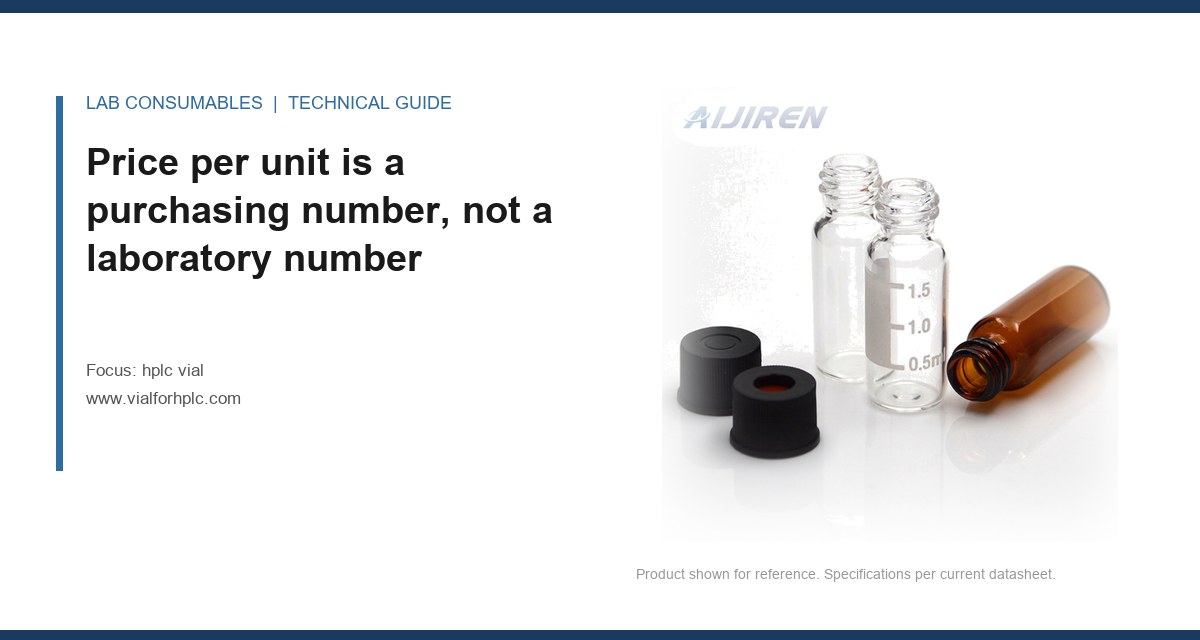
Last quarter a QC lab sent me a spreadsheet showing a 31% rerun rate on one HPLC method, and their first instinct was to blame the column. The column was fine. The vials were a 32 x 11.6 mm, 1.5 mL crimp format with a 9 mm natural rubber/PTFE septum that had been switched to a cheaper lot three months earlier. When I ran the hplc vial cost per test calculation properly, the vials were costing them roughly $4.10 per reported result, not the $0.19 their purchase order showed. That gap between the sticker price and the real cost per test is what this article is about.
Procurement buys vials by the case. The lab pays for them by the injection. Those two numbers are almost never the same, and the difference is where budgets quietly bleed out.
A case of 100 vials at $19.00 is a unit price of $0.19. That number is real, it is auditable, and it is what shows up in the ERP system. It is also almost useless for deciding whether the vial is a good deal, because it ignores everything that happens after the vial leaves the stockroom.
The laboratory number is cost per reported result. It answers a different question: what did it cost me, in consumables and labor, to put one valid result in front of a reviewer? That number includes the vials you used, the vials you threw away, the injections you reran, and the analyst time spent on all of it. For most methods I have costed, the vial itself is under 10% of the cost per reported result. The other 90% is the consequences of the vial.
This is why two vials that differ by four cents in unit price can differ by a dollar in cost per test. The cheap one does not stay cheap once it starts producing failures.
The formula that turns a unit price into a cost per reported result
Here is the calculation I use. It is deliberately simple so that a lab manager can run it from a month of batch records without a data project.
Cost per reported result = (vials consumed per injection x unit price + rerun injections x unit price + labor cost per injection x total injections) / valid results reported
The variable that matters most is vials consumed per injection, and it is almost always greater than 1. You fill a vial, you may prepare a duplicate, you may prepare a standard and a blank alongside it, and you discard a portion of the sample you prepared. In a typical autosampler run with a calibration curve, three QC levels, and a batch of ten samples, the vials consumed per reported sample result runs between 1.6 and 2.4. That already doubles the effective unit price before a single failure occurs.
What counts as labor in this calculation
Only count the hands-on time that scales with the number of injections. That means sample prep, vial filling and capping, tray loading, and the analyst time to review and re-inject a failed run. Do not count instrument run time, because the autosampler works overnight and that clock is not your cost driver. For a mid-range lab I use $45 per hour fully loaded analyst time. If prep and loading take four minutes per vial, that is $3.00 of labor per vial before the instrument even starts.
That single number reframes the whole decision. A vial that saves thirty seconds of prep per sample is worth far more than a four-cent price difference. A vial that fails and forces a rerun costs you the prep time twice, plus the instrument time, plus the review time.
Reruns are the largest hidden line item, and they scale non-linearly
A rerun is not one extra injection. It is a sample you have to re-prepare, re-cap, re-load, re-run, and re-review. In a batch, a single failed injection can force you to rerun the whole batch if the failure is a system suitability failure rather than a single-sample failure. That is the mechanism most spreadsheets miss.
I model rerun cost in three tiers:
- Tier 1, single-sample rerun: one sample re-injected. Cost is roughly one prep plus one injection, about $3.50 in labor and consumables.
- Tier 2, partial batch rerun: a system suitability failure forces re-injection of the standards and QC plus the affected samples. Cost runs $40 to $90 depending on batch size.
- Tier 3, full batch rejection: the run is invalidated and the whole batch is repeated the next day. Cost is the full batch labor plus a day of instrument time, typically $150 to $400.
A vial that produces a 2% Tier 1 rerun rate is tolerable. A vial that produces a 4% Tier 3 rate is not, even if it costs nothing. The math is unforgiving: at a 4% Tier 3 rate on a batch of twenty samples, the rerun cost alone is $6 to $16 per reported result, which dwarfs the vial price.
Rejects happen before the injection, and they are cheaper but more frequent
Not every bad vial reaches the autosampler. Some are caught at prep: a septum that will not seal, a crimp cap that will not hold torque, a vial with a visible chip at the neck. Those are rejects. They cost less per event than a rerun, but they happen more often, and they are the reason a lab’s vial consumption per injection drifts above 2.0.
The reject rate is where the HPLC vial specification actually earns its keep. A crimp vial with a neck OD tolerance of ±0.2 mm and a septum thickness held to ±0.05 mm will seat consistently on a 11 mm crimper set to the correct anvil depth. A vial from a lot where those tolerances drifted will produce a visible tilt on maybe 3 in 100 caps, and the analyst will reject those before loading. That is a 3% reject rate that never shows up as a failed run, but it shows up as extra vials on the requisition.
Why prep time is the reject rate’s twin
Every rejected vial costs the prep time already invested in it. If filling and capping take 90 seconds and you reject 3 in 100, you have lost 2.7 seconds per vial on average, which sounds trivial until you multiply it across a 200-vial batch and add the interruption cost of stopping to re-prepare. I have seen labs recover 20 to 30 minutes per batch simply by moving from a vial with a loose neck tolerance to one with a tight one, because the analyst stopped fighting the crimper.
Two grades, costed side by side
Here is the comparison that matters. These are two real grades I have costed for a 20-sample batch with a 5-point calibration curve and three QC levels, using $45/hour analyst time. The numbers are representative of what I see in practice, not a specific vendor’s quote.
| Parameter | Economy grade (9 mm natural rubber/PTFE, 32 x 11.6 mm) | Analytical grade (9 mm silicone/PTFE, 32 x 11.6 mm, tight tolerance) |
|---|---|---|
| Unit price | $0.19 | $0.31 |
| Vials consumed per injection | 2.3 | 2.0 |
| Prep time per vial | 4.5 min | 3.8 min |
| Reject rate at prep | 3.0% | 0.8% |
| Rerun rate (Tier 1) | 2.5% | 0.6% |
| Rerun rate (Tier 3, full batch) | 1.5% | 0.2% |
| Vial cost per reported result | $0.44 | $0.62 |
| Labor cost per reported result | $7.60 | $5.90 |
| Rerun cost per reported result | $3.10 | $0.55 |
| Total cost per reported result | $11.14 | $7.07 |
Read the last row. The economy vial is 39% cheaper per unit and 58% more expensive per reported result. The vial price is the smallest line in the table, and it is the one procurement negotiates hardest. That is the whole problem in one table.
These numbers are sensitive to batch size and analyst wage, so run them with your own. The direction of the result, however, does not flip. I have costed this for labs running 50 samples a day and labs running 500, and the analytical grade wins on cost per reported result every time the rerun rate is above about 1%.
Field case one: the crimp that would not hold 1.2 Nm
A pharmaceutical QC lab running a stability study reported intermittent septum push-through on their autosampler, roughly 1 in 40 injections, always on the same tray position. The symptom looked like a needle problem, and they had already replaced the needle.
The measurement that identified it was a simple torque check. I had them crimp twenty vials from the suspect lot and twenty from a known-good lot with the same crimper, then measure cap retention with a torque gauge. The good lot held 1.1 to 1.3 Nm. The suspect lot held 0.6 to 0.9 Nm on six of twenty vials, and those six were the ones that failed. The cause was a cap skirt that had been drawn with a wall thickness at the low end of tolerance, so the crimp did not bite. The fix was a lot change plus a crimper anvil depth check, and the push-through rate dropped to zero. The cost of that three-week investigation was about $2,000 in analyst time, which is roughly what the whole vial lot cost.
Field case two: the septum that contaminated the baseline
A contract lab running a method for a small-molecule API started seeing a ghost peak at 4.3 minutes that appeared only in the last third of a 96-vial tray. It was not carryover, because a blank injected after the peak showed nothing. It was not the column, because a column swap changed nothing.
The measurement that identified it was an extractables test: they soaked ten septa from the suspect lot in mobile phase for 24 hours at 40 °C and injected the soak solution. The suspect septa released a compound at the same 4.3-minute retention time, at about 0.8 mAU per septum. The cause was a change in the septum cure, which left a residual that leached into the headspace and then into the sample. The fix was a move to a silicone/PTFE septum with a documented extractables profile, and the ghost peak disappeared. The rerun cost of that investigation was about 180 injections, which at Tier 2 pricing is roughly $700.
Both cases share a pattern. The vial was the last thing anyone suspected, and the cost of proving it was the vial was higher than the vial itself. That is the argument for buying the grade that does not produce the investigation.
The decision rule I give procurement
Do not buy on unit price. Buy on cost per reported result, and set a floor on the specification that protects the rerun rate. Here is the rule I use, stated as a checklist a procurement manager can hand to a supplier:
- Septum: silicone/PTFE, 9 mm for crimp, 1 mm thickness held to ±0.05 mm, with a documented extractables profile. Natural rubber is acceptable only for aqueous, non-sensitive methods.
- Glass: Type I borosilicate, 32 x 11.6 mm for the 1.5 mL format, neck OD tolerance ±0.2 mm, USP Type I hydrolytic resistance per USP <660>.
- Cap: aluminum crimp, 11 mm, with a skirt wall thickness that holds 1.0 to 1.3 Nm retention on a calibrated crimper.
- Lot documentation: certificate of analysis with septum lot and glass lot traceable, plus a sample retention program so you can pull the same lot if a failure appears three months later.
- Acceptance: AQL by defect class, with a critical defect (septum push-through, glass crack) at AQL 0.1 and a major defect (tilt, seal) at AQL 1.0.
That list is not a shopping list. It is the minimum specification that keeps the rerun rate under 1%, and under 1% is where the cost per reported result stops being a surprise. If a supplier cannot meet the septum and cap items, the unit price does not matter.
Where the sibling costs live, and why I am not covering them here
Freight, duty, and contract terms move the landed cost, and they matter. They are also a separate calculation with its own variables, and I have covered them elsewhere. For this decision, hold them constant and compare grades on the same delivered basis. The vial grade decision should not be made on a freight difference.
What I will say is that the grade decision and the contract decision interact. A contract that locks a unit price for two years but does not lock the septum specification is a contract that lets the supplier drift the grade under you. Write the septum and cap tolerances into the contract, not just the price. The chromatography consumables supply chain has enough grade variation that a price-only contract will find the cheap end of it.
A quick way to audit your own cost per test this month
You do not need a new system. Pull three numbers from last month’s batch records: total injections, total valid results reported, and total vials issued from the stockroom. The ratio of vials issued to valid results is your vials-consumed-per-result. If it is above 2.5, you have a reject or rerun problem worth costing. If it is below 1.8, your vial specification is probably right and you should look elsewhere for savings.
Then pull the rerun log and classify each rerun into the three tiers above. Multiply by the tier costs. Add the labor from prep time. That is your real cost per reported result, and it will almost certainly be between $6 and $12 for a method with a healthy vial spec, and above $15 for one with a bad one.
The lab vials catalog will show you the unit prices. The batch record will show you the cost per test. Only one of those numbers should drive the purchase decision.
What to write into the specification before the next tender
If you take one thing from this, take the specification. A vial that meets the septum, glass, and cap items above will hold a rerun rate under 1% in most methods, and that is the threshold where the cost per reported result becomes predictable. A Aijiren brand analytical-grade vial is one example of a product that meets that spec, and the point is not the brand. The point is that the spec is written down, the supplier is held to it, and the lot documentation lets you prove it when a failure appears.
For method-specific acceptance criteria, the U.S. EPA SW-846 test methods and the vendor technical libraries at Agilent, Thermo Fisher, and Restek are where I send analysts who need to justify a septum change to a reviewer. The justification is not “the cheap one failed.” It is “the extractables profile of the specified septum is documented and the rerun rate on the qualified grade is under 1%.”
Buy the grade that keeps the rerun rate under 1%, write the septum and cap tolerances into the contract, and audit vials-issued-per-valid-result every quarter. The unit price will look higher on the purchase order and lower on the batch record, and the batch record is the number your finance director will eventually ask for.
References & further reading
Related resources from our lab consumables network:
- Hplc Vial at vialforhplc.com
- Chromatography Consumables at chromatographyconsumables.com
- Lab Vials at labvials.com
- Aijiren Brand at aijirenvials.com
External references and standards: