
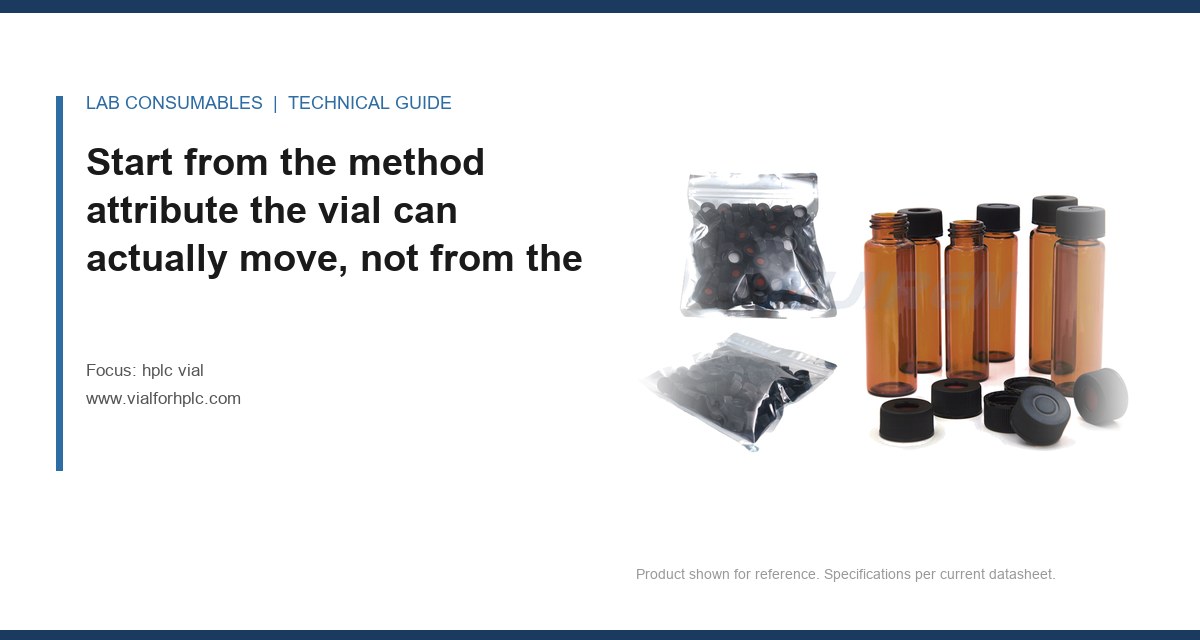
Lot 22-1147 of 9 mm screw-thread vials arrived with a septum lot number that did not match the certificate in the box, and the first run on it showed a 41% drop in peak area for the 0.5 µg/mL standard compared with the previous week. The analyst’s first instinct was the column. It was the vial. That single event is the most common way a supplier or lot change turns into a revalidation question, and the answer depends on which change actually occurred, not on how nervous the reviewer is.
This article is about revalidation triggers when an hplc vial supplier or lot changes: which changes force a full method revalidation, which only need verification, and how to write the change-control entry so an auditor or inspector accepts the reasoning without a finding. If you already know what a vial is and why it sits inside the method, this is the decision layer above that.
Start from the method attribute the vial can actually move, not from the supplier name
A new supplier is not a validation event by itself. A new material property that touches a validated method attribute is. The vial has exactly four surfaces that can move a result: the glass in contact with sample, the septum in contact with sample and headspace, the closure’s seal, and the dimensional fit in the autosampler tray and needle path. Map each change to the attribute it can shift before you decide anything.
- Glass surface chemistry and extractables shift peak area, ghost peaks, and low-level quantitation at or below 1 µg/mL.
- Septum formulation shifts volatile loss, sorption of hydrophobic analytes, and siloxane extractables.
- Closure and seal shift evaporation loss on long runs and headspace integrity.
- Dimensional tolerance shifts needle depth, coring, and tray seating, which lands on precision (RSD%) rather than accuracy.
That mapping is the whole game. A change that does not touch a validated attribute is a verification item. A change that touches one is a revalidation candidate, and the scope of revalidation is the attribute, not the entire method. I have watched labs revalidate an entire multi-analyte method for a septum color change and I have watched labs ship a new glass source with no work at all. Both are wrong, and both get written up.
The change classes: what forces revalidation, what needs verification, what needs a note
I run this as a three-tier classification. It is not in any pharmacopeia as a table, but it survives inspection because every tier is justified by the attribute map above. Reference the general validation framework in U.S. EPA SW-846 and USP <621> for the chromatographic system suitability side; the vial-specific logic is yours to write down.
Tier 1: full revalidation of the affected attribute
Full revalidation, meaning repeat of accuracy, precision, linearity, and LOD/LOQ at the affected level, is triggered when any of these occur:
- Glass source or forming process change at the supplier, for example a move from molded to tubing-derived vials, or a new furnace line. This changes surface extractables and can shift low-level recovery.
- Septum polymer family change, for example silicone to silicone/PTFE-faced, or a change in the PTFE facing thickness below 0.10 mm. This is the single biggest extractables lever.
- Any change to a validated method’s lowest calibration standard response that fails system suitability after a lot change: tailing factor above 2.0, or RSD of five replicate injections above 2.0% for a <1 µg/mL standard.
- Closure torque or seal design change on a method with a validated evaporation limit, for example a 24-hour autosampler residency study.
Tier 2: verification only, no revalidation
Verification means a documented comparison run, typically system suitability plus one accuracy check at the low standard, on the new lot against the old. No revalidation. This covers:
- Same supplier, same specification, new lot number. Normal lot-to-lot variation. Verify with a suitability run and archive the data.
- Second-source supplier at identical drawing and material spec, where the septum polymer and glass type are unchanged and the dimensional tolerances meet the same drawing.
- Color or marking change on the cap with no material change.
- Packaging change (bag count, tray layout) with the same vial geometry.
Tier 3: change-control note only
Documentation update, no analytical work:
- Supplier name change through acquisition with the same manufacturing site and process.
- Certificate of analysis format change with the same tested values and methods.
- Catalog number change with no physical change.
The trap in Tier 3 is assuming an acquisition is harmless. It is harmless only if the site and the forming line are the same. If the new owner moves production to a different plant, it is Tier 1 whether the part number changed or not. Ask the question in writing and keep the answer.
Decision table you can paste into your change-control SOP
| Change | Class | Minimum work | Acceptance |
|---|---|---|---|
| New lot, same supplier, same spec | Tier 2 | Suitability + 1 low-standard accuracy check | RSD ≤ 2.0%, recovery 98–102% |
| Second-source, identical material and drawing | Tier 2 | Suitability + accuracy + 1 extractables blank | No ghost peak above 0.1% of main peak area |
| Glass forming process change | Tier 1 | Accuracy, precision, linearity, LOQ | Per validated acceptance criteria |
| Septum polymer or facing change | Tier 1 | Repeat low-level accuracy + extractables | Recovery within validated range |
| Closure torque or seal design change | Tier 1 (if evaporation validated) | Repeat residency/evaporation study | ≤ 2% loss over validated hold time |
| Color, marking, packaging | Tier 2 (documentation) | Suitability only | Pass |
| Supplier acquisition, same site/process | Tier 3 | Note + written confirmation | N/A |
Torque deserves a number because inspectors ask for one. For 9 mm screw-thread closures I use 0.6–0.9 N·m as the working band on a calibrated torque tester, and I record the value on the change record. Above roughly 1.2 N·m you start to deform the septum and invite coring; below 0.4 N·m you get evaporation loss on a 24-hour residency. That band is a process control, not a spec, and it belongs in the change entry.
Two field cases where the change looked routine and was not
Case 1: a “same spec” second source that moved the LOQ
A contract lab qualified a second-source 2 mL clear vial at what the drawing called identical dimensions. The method was a 0.2 µg/mL assay for a hydrophobic API. System suitability passed on day one. By day three the low standard had drifted to 87% recovery and the blank showed a siloxane peak at 0.15% of the main peak area. The measurement that identified it was a simple extractables blank: 1 mL of mobile phase in ten vials from each source, held 24 hours at ambient, injected. The new source produced a peak the old source did not. Root cause was the septum facing: the drawing specified “PTFE-faced silicone” with no facing thickness, and the new source used a thinner facing that let silicone migrate. The fix was to write PTFE facing ≥ 0.13 mm into the specification and re-qualify. That is a Tier 1 event that looked like Tier 2 because the drawing was underspecified. The lesson: a drawing that tolerances the glass but not the septum facing is not a specification, it is a wish. This is exactly the kind of gap that shows up across a whole chromatography consumables portfolio, not just one part.
Case 2: a lot change that failed precision, not accuracy
A pharma QC lab moved to a new lot from the same supplier. Accuracy checks passed. Precision on a 10-injection sequence degraded from 0.4% RSD to 1.9% RSD, still inside the 2.0% limit, so nobody flagged it. Two weeks later a run failed suitability at 2.3%. The measurement that found it was a needle-depth and tray-seat check: the new lot’s neck height was at the top of the drawing tolerance, about 0.4 mm higher than the previous lot’s mean, and the autosampler was seating inconsistently. The fix was a dimensional check on incoming lots against a neck height tolerance of ±0.2 mm and a supplier conversation about process capability. That is a Tier 2 verification that should have caught a precision trend, and the change record needed a trend review, not just a pass/fail.
How to write the change-control entry so an inspector accepts it
An auditor does not reject a change because it was risky. They reject it because the record does not show that someone reasoned about the risk. Write the entry so the reasoning is visible in five fields.
- What changed, physically. Not “new supplier.” Write “septum polymer changed from silicone to silicone/PTFE-faced, facing 0.10 mm, same 9 mm screw thread, same 2 mL glass.” Physical, specific, measurable.
- Which validated attribute it can affect, and why. One or two sentences citing the attribute map. “Facing thickness affects low-level extractables; method LOQ is 0.2 µg/mL, so extractables are in scope.”
- The tier and the justification. Cite the SOP clause and the table row. “Tier 1 per SOP-QC-014 Table 2, septum polymer change.”
- The work performed and the numbers. The actual RSD, the actual recovery, the actual extractables blank result. A pass with no number is a finding waiting to happen.
- The disposition and the trigger for the next review. “Accepted. Next review on lot change or 12 months, whichever first.”
Two things get left out and both get written up. First, the pre-change baseline. If you do not have the old lot’s numbers in the record, the new lot’s numbers mean nothing. Keep a rolling baseline of suitability and low-standard recovery per method, and attach it. Second, the supplier’s own change notification. If your supplier does not notify you of a forming-line or septum change, that is the finding, not the vial. Put a change-notification clause in the supply agreement and reference it in the entry.
The technical basis for what “in scope” means is worth citing precisely. USP <621> sets the system suitability framework, and the general validation expectations sit in ICH Q2(R2) for method validation. The vial is not named in most of these, which is why your own attribute map carries the argument. If you are sourcing across a mixed catalog, the HPLC vial selection and the change history of each part matter more than the catalog page.
The verification protocol: what to run, in what order, and the numbers that stop it
For a Tier 2 verification, run this sequence on the new lot against the retained old lot. It takes about half a day and it is defensible.
- System suitability, five injections of the low standard. Stop if RSD exceeds 2.0% or tailing exceeds 2.0.
- Extractables blank: mobile phase in ten vials, 24 hours ambient, inject. Stop if any peak exceeds 0.1% of the main peak area or 3× the baseline blank.
- Accuracy at the low standard: recovery must fall within the validated range, typically 98–102% at the low end.
- Dimensional spot check: neck height within ±0.2 mm, and a tray-seat check on the autosampler.
- Evaporation check only if the method has a validated hold time: weight loss ≤ 2% over that hold.
If any stop criterion trips, escalate to Tier 1 for the affected attribute. Do not average your way past a stop criterion. I have seen a lab run the blank three times until it passed. That is not verification, that is shopping for a result, and the data integrity reviewer will find it.
Where the specification, not the change, is usually the real failure
Most revalidation disputes I have mediated were not about whether to revalidate. They were about a specification that never pinned the property that changed. If your incoming spec says “clear glass, 2 mL, 9 mm screw thread” and nothing about septum facing thickness, glass type (Type I borosilicate versus Type II), or neck height tolerance, then every lot change is a coin flip and every revalidation decision is a guess. Fix the spec and the change-control decisions become mechanical.
I would put these on the drawing: septum facing ≥ 0.13 mm PTFE, glass Type I borosilicate, neck height ±0.2 mm, closure torque band 0.6–0.9 N·m, and a stated extractables limit tied to the method LOQ. For a broader view of how these parts are specified across a supplier’s range, the Aijiren brand documentation is a reasonable reference point for what a complete drawing looks like. The lab vials catalog also shows how dimensional tolerances are published when they are taken seriously. For instrument-side handling limits, the autosampler documentation from Agilent and Thermo Fisher gives the tray and needle-depth tolerances you are designing against, and Restek publishes useful extractables background for septa.
The decision rule
Revalidate when a supplier or lot change alters a material property that a validated method attribute depends on, and verify when it does not. Write the change-control entry so the physical change, the affected attribute, the tier, the numbers, and the next review trigger are all visible on one page. A change that touches the septum facing, the glass forming process, or a validated closure torque is a revalidation event. A lot number, a second source at identical material spec, or a color is a verification event. The rest is a note. If you cannot tell which one you are looking at, your specification is incomplete, and the fix is to complete the drawing before the next lot arrives, not to revalidate around a gap you cannot see.
References & further reading
Related resources from our lab consumables network:
- Hplc Vial at vialforhplc.com
- Chromatography Consumables at chromatographyconsumables.com
- Lab Vials at labvials.com
- Aijiren Brand at aijirenvials.com
External references and standards: