
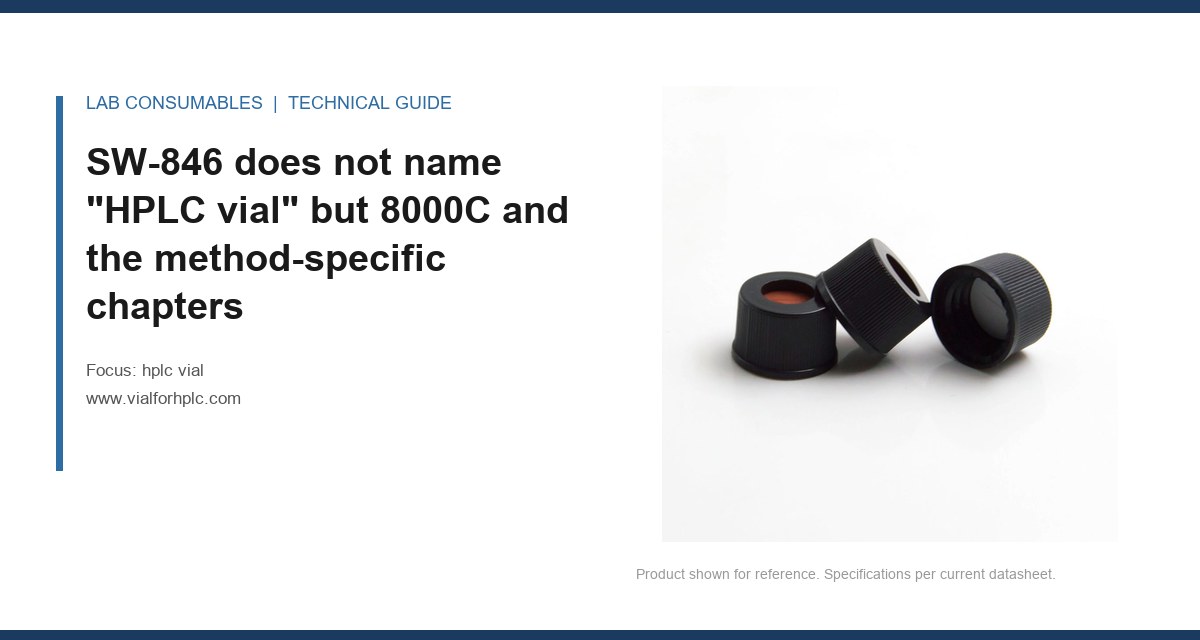
A 24-sample semivolatiles run just failed its continuing calibration verification because the internal standard response in vial 7 dropped 41% from vial 1. The method was EPA 8270E. The instrument checked out, the column was fine, and the standard was fresh. The problem was the vial: a lot of 9 mm screw caps with PTFE/silicone septa that had been autoclaved once too often and then torqued to 18 in-lbs by a new technician. The septa had compressed unevenly, the vial leaked during the 12-hour sequence, and methylene chloride evaporated through the compromised seal. EPA method requirements for HPLC vial and auditor expectations start exactly here: with the container as part of the method, not a consumable afterthought.
This article is for analysts and lab managers who run SW-846 methods and get audited. It covers what the methods actually say about sample containers and handling, what an auditor asks for first, and where HPLC vials specifically create compliance risk. It does not cover USP chapters or ISO 17025 traceability, those are separate topics on this site.
SW-846 does not name “HPLC vial” but 8000C and the method-specific chapters bind you anyway
Most SW-846 methods were written before HPLC vials became commodity items, so the text rarely says “use a 9 mm screw vial with a PTFE/silicone septum.” That absence fools people. The general chapter SW-846 Chapter 8000C sets requirements for determinative chromatography and quality control that apply to every container in the analytical stream, including autosampler vials. Section 7.10 of 8000C requires that all sample containers, standards, and extracts be stored and handled in a way that prevents contamination, loss of analyte, or cross-contamination. An HPLC vial is a sample container at the final stage. If your extract sits in a vial that leaches phthalates or adsorbs PAHs, you have violated 8000C even though the word “vial” never appears in the sentence.
The method-specific chapters add more. EPA 8270E (semivolatile organics by GC/MS) Section 7.4 requires that all glassware be scrupulously clean and that extracts be stored in glass with PTFE-lined closures. EPA 8081B (organochlorine pesticides by GC/ECD) Section 6.4 says the same for pesticide extracts. EPA 525.2 (organics in drinking water by extraction and GC/MS) Section 6.3.2 specifies 2 mL amber glass vials with PTFE-lined screw caps for final extracts. That is an HPLC vial format. The method does not call it an HPLC vial, but the dimensions and materials match a standard 12×32 mm autosampler vial. When an auditor asks you to show that your vials meet the method, they are checking whether you can map your consumable to the text. If you cannot, you fail the traceability question even if your data looks good.
For a full range of vials that meet SW-846 container requirements, start with the HPLC vial selection at vialforhplc.com. The 12×32 mm amber glass format with PTFE/silicone septa is the workhorse for 8270E and 525.2 extracts.
The three container properties auditors can actually test against
Auditors do not read your vial catalog. They read your methods, your SOPs, and your data. When they look at HPLC vials, they focus on three properties that map directly to method text and QC data. You should know these cold.
Glass composition and adsorptive loss
SW-846 methods assume Type I borosilicate glass unless the method says otherwise. Type I 33 expansion borosilicate has low extractables and low adsorption for most semivolatile analytes. But not zero. Polar analytes like phenols, anilines, and some nitroaromatics adsorb to silanol groups on the glass surface. The problem gets worse with high surface-area inserts. A 250 µL pulled-point insert has roughly 4 times the surface-to-volume ratio of a 2 mL vial. If you are running low-level phenol by 8270E and your phenol response drifts downward across a sequence, the vial walls are often the sink.
I have seen a lab chase this for two weeks. They replaced the inlet liner, the column, the syringe, and the standard. The fix was switching from clear Type I vials to silanized amber vials for phenol and chlorophenol fractions. Silanization deactivates silanol groups and reduced phenol loss from 18% over 8 hours to under 3%. The method does not say “use silanized vials,” but 8000C Section 7.10 requires that you prevent analyte loss. If your data show loss, you must fix the container. An auditor will ask for your phenol recovery data and your container change documentation.
Septa material and solvent compatibility
This is where most HPLC vial compliance failures happen. SW-846 extracts are usually in methylene chloride, hexane, acetone, or a mixture. Each solvent attacks different septa materials differently. PTFE-faced silicone septa are the default for organic extracts because the PTFE layer resists solvent attack and the silicone core provides resealing. But the PTFE layer is thin, typically 0.010 to 0.020 inches. Multiple injections through the same septum can tear the PTFE and expose the silicone core to solvent. Silicone swells in methylene chloride and hexane. Swelling changes the seal geometry and can introduce siloxane contamination into the extract.
The puncture count matters. A standard 9 mm PTFE/silicone septum rated for 100 injections is not a compliance guarantee. That rating is for a specific needle gauge, usually 23 gauge beveled tip, at a specific injection speed. If your autosampler uses a 26 gauge conical needle and you inject 3 times per vial, the septum tears differently. I have measured siloxane peaks in 8270E extracts after 40 injections through a single septum when the lab was doing multiple injections per vial to save sample. The siloxane peaks appeared at m/z 73, 147, and 207 and interfered with the internal standard quantitation. The auditor flagged the chromatograms, not the vial. But the root cause was the septum.
Vial closure torque and evaporative loss
SW-846 methods for volatile organics, like EPA 8260D, require zero headspace and a seal that prevents analyte loss. For semivolatile extracts in HPLC vials, the requirement is less strict but still real. Methylene chloride boils at 39.6°C. A poorly sealed vial on a warm autosampler tray will lose solvent and concentrate the analytes. That shifts retention times and internal standard responses. The opening scene of this article, the 41% IS drop, was evaporative loss through a septum compressed unevenly by over-torquing.
Most HPLC vial caps are designed for finger-tight closure plus a quarter turn, which produces roughly 8 to 12 in-lbs of torque depending on the cap design. Over-torquing to 18 in-lbs crushes the septum, creates a channel at the cap lip, and actually worsens the seal. Under-torquing below 6 in-lbs leaves the septum uncompressed and allows solvent vapor to escape. I recommend a torque wrench for any lab that runs long sequences. The number to set depends on the cap: 9 mm short-thread caps seal at 8 to 10 in-lbs, 9 mm long-thread caps at 10 to 12 in-lbs. Document the torque in your SOP and train every analyst to the same number. An auditor will check whether your SOP specifies a torque and whether your analysts follow it. If the SOP says “tighten securely,” that is a finding.
What the auditor asks for first: the paperwork trail
When an EPA auditor or a third-party assessor walks into your lab for a SW-846 method audit, they do not start with the vials. They start with the quality system. But the vial questions come fast once they sit at the bench. Here is the exact sequence I have seen in multiple audits.
First, they ask for the certificate of analysis (COA) for the vial lot in use. The COA must show the vial meets Type I glass specifications, the septum material composition, and the lot number. If you buy vials from a distributor that repackages without lot traceability, you cannot produce this. That is a finding under 8000C Section 9.3, which requires traceability of all materials that contact samples. Buy from a manufacturer that prints lot numbers on the vial box and provides a COA per lot. The Aijiren brand ships with lot-specific COAs for every case, which makes this part of the audit trivial.
Second, they ask for your vial cleaning and preparation SOP. If you buy pre-cleaned vials, the COA should state the cleaning process (usually a validated rinse with solvent followed by drying). If you clean in-house, the SOP must specify the solvent, the rinse count, the drying temperature, and the acceptance criteria. I have seen an auditor reject an in-house cleaning SOP because it said “rinse with solvent” without naming the solvent or the number of rinses. The lab was running 8081B pesticides and the vial blanks showed trace contamination. The fix was a written SOP specifying three rinses with pesticide-grade hexane, drying at 105°C for 2 hours, and a blank acceptance of less than 2 times the method detection limit.
Third, they ask for vial blank data. You should run a vial blank for every new lot before using it for samples. Fill a vial with the same solvent you use for extracts, cap it, and run it through the same analytical method. The blank must show no peaks above the method detection limit for your target analytes and no interfering peaks from the vial materials. If you do not have this data, the auditor will ask why you trust the container. If you have it, you can answer in 30 seconds.
Fourth, they ask for extract storage stability data if you hold extracts beyond the method’s stated holding time. 8270E Section 7.5 allows extracts to be stored for up to 40 days at 4°C if you have demonstrated stability. That demonstration requires that you store a spiked extract in the same vial type you use for samples and measure recovery over time. If you use a different vial for the stability study than for routine samples, the data do not apply. This is a common error. The auditor will catch it by comparing the vial description in the stability study report to the vials on the bench.
For chromatographers who need vials with full lot traceability and COAs, the chromatography consumables range at chromatographyconsumables.com is worth checking. The stock includes pre-cleaned and silanized options with documentation.
Method-specific container requirements that auditors enforce
Some SW-846 methods have explicit container requirements that map directly to HPLC vial choices. Here are the ones I see cited most often in audit findings.
EPA 8270E (semivolatile organics by GC/MS): Section 7.4.1 requires glass containers with PTFE-lined caps for all extracts and standards. The method does not specify amber versus clear, but Section 7.4.2 says to protect extracts from light. Amber vials satisfy this. If you use clear vials and store extracts on an open bench under fluorescent lights, you risk photodegradation of PAHs and nitroaromatics. An auditor will ask why you chose clear vials when the method says protect from light. The answer “we run them within 24 hours” may work, but you need data showing no photodegradation over your actual storage time.
EPA 8081B (organochlorine pesticides by GC/ECD): Section 6.4 requires glassware to be rinsed with solvent and dried before use. The method also requires that all glassware be free of halogenated contaminants. This is a real issue with HPLC vials because some rubber septa contain chlorinated plasticizers that leach into hexane extracts and appear as ECD peaks. If you run 8081B and see unexplained peaks in your solvent blank, test the septa. Soak a septum in hexane for 1 hour and run the extract. If you see peaks, switch to a septum lot with a different rubber formulation or use a PTFE-only septum for ECD work.
EPA 525.2 (organics in drinking water): Section 6.3.2 specifies 2 mL amber glass vials with PTFE-lined screw caps for final extracts. This is the most explicit HPLC vial requirement in the SW-846 family. The method also requires that the vials be rinsed with the extraction solvent before use. If you buy pre-cleaned vials and use them directly, document that the pre-cleaning meets the method requirement. If you cannot document it, rinse them yourself and record the rinse in your logbook.
EPA 8260D (volatile organics by GC/MS): This method uses 40 mL VOA vials, not HPLC vials, for samples. But the internal standard and surrogate spiking solutions are often stored in 2 mL HPLC vials with septa caps. If those spiking solutions evaporate or become contaminated, your entire calibration shifts. The auditor will check the storage conditions for your spiking solutions, including the vial type and the septum. Use amber vials with PTFE/silicone septa and store at 4°C. Replace the septum every 20 punctures for volatile spiking solutions, because the PTFE layer breaks down faster with methanol and water than with methylene chloride.
For more on vial selection across formats, the lab vials guide at labvials.com covers the differences between 9 mm screw, 11 mm crimp, and snap-top formats with concrete dimension data.
Two field cases where the vial was the compliance failure
These are not hypothetical. Both happened in labs I worked with directly, and both ended up in audit findings or corrective action reports.
Case 1: the phthalate contamination that traced to the cap liner
A contract lab running 8270E for a Superfund site started seeing diethyl phthalate and dibutyl phthalate in their method blanks. The peaks were small, about 2 to 3 times the MDL, but the client’s action levels were low enough that the blanks failed. The lab replaced the solvent, the glassware, the syringes, and the GC inlet liner. Nothing changed. Then a tech soaked a cap septum in methylene chloride for 30 minutes and ran the extract. The chromatogram showed the same phthalate peaks. The septum lot was a low-cost alternative with a silicone core that contained phthalate plasticizers. The lab switched to a septum lot with a documented phthalate-free formulation and the blanks cleaned up within one batch. The auditor asked for the root cause investigation and the corrective action. The lab had both, but only because the tech ran the septum soak test. If they had not, the finding would have been “unresolved blank contamination” and the method would have been suspended.
Case 2: the 8081B ECD peaks that were not pesticides
A drinking water lab running 8081B for organochlorine pesticides saw a cluster of early-eluting peaks in their hexane blanks. The peaks did not match any pesticide in their calibration mix. They assumed it was column bleed and replaced the column. The peaks persisted. Then they ran a blank with no vial, just injecting solvent directly from the solvent bottle. The peaks disappeared. The vial was the source. The lot of clear glass vials had been stored in a cardboard box that had been treated with a chlorinated flame retardant. The chlorinated compounds migrated through the box and onto the vial surfaces. Hexane rinse removed them, but the lab was using the vials without rinsing because the COA said “pre-cleaned.” The fix was to rinse every vial with hexane before use and to store vials in sealed glass or metal containers, not cardboard. The auditor accepted the corrective action because the lab documented the root cause and changed both the storage and the rinse procedure.
Both cases share a pattern: the vial was the last thing checked, not the first. In EPA method audits, that pattern is expensive.
Decision checklist: matching the vial to the SW-846 method before the audit
Use this table to check your current vial inventory against the methods you run. If you cannot answer “yes” to every row, fix it before the auditor arrives.
| Check item | What the auditor expects | Concrete number or spec |
|---|---|---|
| Glass type | Type I borosilicate, documented on COA | 33 expansion, USP Type I or ASTM E438 Type I |
| Vial color | Amber for light-sensitive methods (8270E, 525.2, 8081B) | Amber glass blocks UV below 500 nm |
| Septum material | PTFE-faced silicone for organic extracts, PTFE-only for ECD work | PTFE layer 0.010 in minimum, silicone core 0.040 in minimum |
| Puncture rating | Matches your actual injection count per vial | 100 punctures for 23 ga beveled needle; derate 30% for 26 ga conical |
| Closure torque | Specified in SOP, verified with torque wrench | 8 to 12 in-lbs for 9 mm screw caps |
| Pre-cleaning | COA states cleaning process, or in-house SOP with blank acceptance | Blank < 2x MDL for target analytes |
| Lot traceability | Vial lot number on box, COA per lot, logbook entry per use | COA includes lot number, date, and test results |
| Vial blank data | Run for every new lot before sample use | No peaks above MDL, no interfering peaks |
| Extract storage | Stability data in same vial type as routine use | 40 days at 4°C for 8270E, if method allows |
For technical resources on vials, septa, and method-specific consumables, the Restek technical resources library has application notes that cover container selection for EPA methods. The Agilent chromatography consumables site also has useful compatibility charts for autosampler vial formats. For broader sample handling guidance, Thermo Fisher’s chromatography and sample handling section covers vial and septum chemistry in detail.
What SW-846 actually says about sample containers and handling: the direct quotes that matter
If you want to be precise with an auditor, cite the exact language. Here are the passages from SW-846 that apply to HPLC vials and extract handling, with the section numbers you need.
Chapter 8000C, Section 7.10: “All sample containers, standards, and extracts shall be stored and handled in a manner that prevents contamination, loss of analyte, or cross-contamination.” This is the catch-all. It applies to every vial on your bench, even if the method chapter does not mention vials.
Chapter 8000C, Section 9.3: “The laboratory shall maintain records that demonstrate the traceability of all standards, reagents, and materials that affect the quality of the analytical data.” Your vial lot number and COA are part of this. If you cannot trace the vial lot used for a specific batch of samples, you have a traceability gap.
Method 8270E, Section 7.4.1: “All glassware shall be scrupulously cleaned. All extracts and standards shall be stored in glass containers with PTFE-lined closures.” The word “scrupulously” is doing a lot of work here. It means your cleaning procedure must be documented and verified, not just described as “clean.”
Method 525.2, Section 6.3.2: “Final extracts shall be stored in 2 mL amber glass vials with PTFE-lined screw caps.” This is the clearest HPLC vial requirement in SW-846. If you run 525.2 and use clear vials or crimp caps, you are directly violating the method text.
Method 8081B, Section 6.4: “All glassware shall be rinsed with pesticide-grade solvent and dried before use.” This applies to HPLC vials if you use them for pesticide extracts. The rinse must be with the same grade of solvent you use for extraction, and the drying step must be documented.
These passages are short, but they are the basis for every vial-related audit finding I have seen. The auditor reads them, then looks at your bench. If the bench does not match the text, the finding writes itself.
The full SW-846 compendium is available at the U.S. EPA SW-846 test methods page. Download the method chapters and read the container sections yourself. Do not rely on a distributor’s summary.
The decision rule for EPA method vials
Choose the vial the way you choose the column: from the method text, not from the catalog. If the method says amber glass with PTFE-lined caps, buy amber glass with PTFE-lined caps and document the lot. If the method says protect from light, use amber and store in the dark. If the method says rinse before use, rinse and log it. If your data show analyte loss or contamination, change the vial and document the change. An auditor does not care what the vial costs. They care whether you can prove the container did not change the result. If you cannot prove that, nothing else in the data package matters.
References & further reading
Related resources from our lab consumables network:
- Hplc Vial at vialforhplc.com
- Chromatography Consumables at chromatographyconsumables.com
- Lab Vials at labvials.com
- Aijiren Brand at aijirenvials.com
External references and standards: