
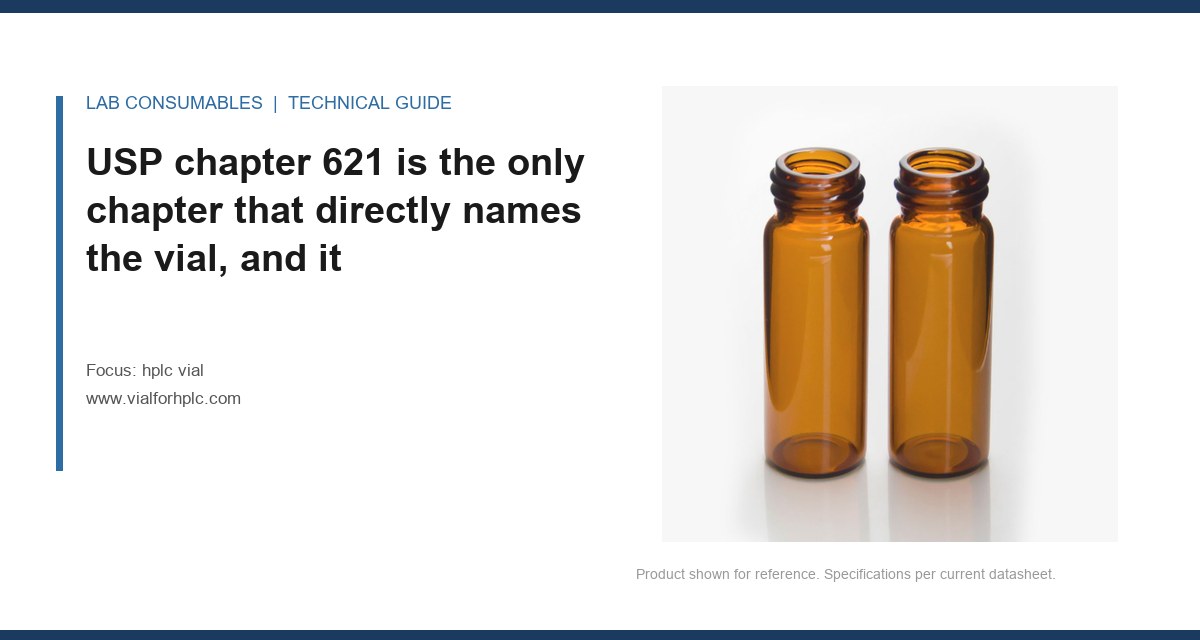
A stability-indicating method for a lyophilized peptide had passed validation in August, then failed system suitability in November. The same lot of mobile phase, the same column, the same reference standard. The only variable was a new case of 12×32 mm screw-top vials from a different supplier. Carryover jumped from 0.05% to 0.31%. The investigation took three days and ended at the vial. The USP chapters that govern that vial were never consulted during the supplier change, and that is exactly how a validated method quietly stops being validated.
USP chapter 621 is the only chapter that directly names the vial, and it names it once
Most people assume USP has a dedicated monograph for HPLC vials. It does not. What it has is a set of chapters whose requirements reach the consumable indirectly, through the method’s performance specifications. The phrase USP requirements for hplc vial in a validated method does not point to a single test you run on a vial. It points to a chain of obligations that starts with system suitability and ends with your own documented specification.
USP General Chapter <621> Chromatography is the anchor. It defines system suitability parameters: resolution, tailing factor, theoretical plates, repeatability. It also states that the chromatographic system includes the injection system. The vial is part of the injection system. That one sentence is the legal hook. When a method is validated under USP, every component that touches the sample path becomes part of the system whose suitability you must demonstrate. A vial that adsorbs analyte, sheds particles, or leaks solvent is a system suitability failure, not a consumable complaint.
Chapter <1058> Analytical Instrument Qualification extends the same logic. It classifies instruments and components into groups A, B, and C based on the risk they pose to data quality. A vial is group C in practice, even though USP does not list it explicitly. Group C items require a defined specification and periodic verification because their failure directly changes analytical results. If your method validation report does not name the vial part number, material, and closure type, an auditor can reasonably argue that the method was never fully validated.
USP 661.1 and 661.2 reach the vial through the container closure system
Chapter <661.1> Plastic Materials of Construction and <661.2> Plastic Packaging Systems for Pharmaceutical Use apply to the vial body when it is made of polypropylene. The 12×32 mm autosampler vial is almost always polypropylene. USP 661.1 sets extractables and leachables expectations for the polymer itself. USP 661.2 sets the performance tests for the finished packaging component: biological reactivity, physicochemical tests, and the extractables profile under defined conditions.
Here is what changes in a validated method. If your method uses a mobile phase with more than 20% organic modifier, or a sample diluent with DMSO or DMF, the vial polymer is being stressed. USP 661.2 does not require you to re-test every vial lot. It requires that the vial you use is appropriate for the solvent system in your method. That appropriateness is demonstrated by your method’s specificity and accuracy during validation. Change the vial supplier without repeating the accuracy and precision runs, and you have an unvalidated change under <1225> Validation of Compendial Procedures.
Glass vials, including Type I borosilicate 33 expansion and 51 expansion, fall under <660> Containers – Glass. The USP surface chemistry tests in 660 matter when your analyte is a metal-sensitive compound or a basic peptide. A borosilicate vial with poor surface treatment can bind analyte at the 1 to 10 ng/mL level. That is the range where many impurity methods operate. The surface chemistry test in 660 is a hydrolytic resistance test, not an adsorption test, so it will not catch analyte binding. It only confirms the glass class. Your method validation must catch the binding through recovery at the LOQ.
What USP actually requires you to specify versus what it leaves to the lab
I have sat through enough audit responses to know the exact gap. USP requires you to demonstrate that the method is capable of producing results that meet predetermined acceptance criteria. It does not require you to use a specific vial brand, a specific septa formulation, or a specific closure torque. It requires you to control those variables. The control mechanism is your own specification.
A defensible vial specification for a validated USP method includes at least these parameters:
- Vial format and dimensions: 12×32 mm, 9 mm short thread, or 11 mm crimp. Specify the outer diameter tolerance, typically ±0.15 mm for 12×32 mm.
- Vial material: Type I borosilicate glass, 33 expansion or 51 expansion, or USP Class VI polypropylene. Do not write “glass” or “plastic”.
- Septa material: PTFE/silicone, PTFE/butyl, or pre-slit PTFE/silicone. Specify the PTFE thickness in mil, typically 1.0 to 2.0 mil for multi-injection use.
- Closure type and torque: 9 mm screw caps require a defined application torque. Most autosampler manufacturers specify 17 to 22 inch-ounces for 9 mm caps. Crimp caps need a defined crimp jaw setting.
- Injection count rating: the number of needle punctures the septum is rated for at a given needle gauge. A standard 1.0 mil PTFE/silicone septum is rated for 3 to 5 punctures with a 23 gauge needle before coring risk rises.
- Extractables statement: the supplier’s certificate should state compliance with USP 661.1 for the polymer components and USP 660 for glass.
What USP leaves to the lab is the actual performance verification. No USP chapter tells you how many injections a septum must survive. No chapter gives you a carryover limit for a vial. Those numbers come from your method’s system suitability and your own historical data. That is the part most labs miss: they treat the vial as a commodity and then wonder why the method drifts.
Where the vial interacts with USP system suitability math
System suitability is a set of calculations, not a physical test. But every calculation has a physical input. The injection repeatability requirement in USP 621 is typically RSD ≤ 1.0% for five or six replicate injections of the standard. If your vial septum is coring, the needle carries a plug of septum material into the injection port on injection three. The peak area for injection three drops. The RSD climbs past 2.0%. The system fails, and the vial is the cause, even though the calculation never mentions the vial.
Carryover limits are method-specific, but most validated impurity methods set the limit at ≤ 0.05% of the active peak. A vial with poor surface chemistry or a septum that leaches siloxanes into the sample can push carryover to 0.1% or higher. The leachate co-elutes with a late-eluting impurity or the active peak itself. The carryover calculation flags it, but the root cause is the vial extractables profile, which is a USP 661.1 issue.
Resolution between two critical peaks is another place where the vial shows up. If the vial sheds polypropylene microparticles into the sample, those particles can accumulate on the column inlet frit. Backpressure rises, peak shape degrades, and resolution between the critical pair drops below the 2.0 minimum. The column gets blamed. The vial is the source.
Two field cases where the USP requirement pointed to the vial
Case one: a 0.3% carryover failure in a genotoxic impurity method. The method had a carryover limit of 0.05% for a nitrosamine impurity. After switching to a lower-cost 9 mm screw vial, carryover measured 0.12% on the first day. The lab ran the standard six injections and the RSD was 1.4%, above the 1.0% limit. The investigation measured the vial’s extractables by LC-MS. The new vial’s silicone septum released cyclic siloxanes into the sample diluent, which was 50% acetonitrile. The siloxanes co-eluted with the nitrosamine. The fix was a switch to a PTFE/butyl septum with a 2.0 mil PTFE barrier and a documented extractables statement for 50% acetonitrile contact. Carryover returned to 0.04%. The method was re-validated for the vial change under USP 1225.
Case two: RSD drift in a peptide assay using a 12×32 mm glass vial. The method had run for 18 months with RSD consistently at 0.6%. A new lot of vials from the same supplier produced RSD of 2.1% on the first system suitability run. The lab measured the vial’s internal surface chemistry by TOF-SIMS and found a higher concentration of sodium and calcium at the glass surface than the previous lot. The peptide, a basic molecule with a pI of 9.2, was adsorbing to the ion-rich glass surface at the 10 ng/mL LOQ level. The fix was a documented incoming inspection that included a recovery test at the LOQ using a reference peptide solution. The vial supplier was asked for a certificate of analysis showing the surface treatment process. The method’s accuracy at the LOQ was re-verified, and the lot was released for use.
A decision checklist for the vial in a USP-validated method
When I audit a method, I use a specific checklist. It is not long, but each item ties to a USP chapter or a validation obligation. If the answer to any item is “we don’t know”, the method has a documentation gap that an auditor can exploit.
| Checklist item | USP reference | Acceptance criterion |
|---|---|---|
| Vial material and format named in the method | <1225> | Part number, material, and dimensions written in the method file |
| Septum material and PTFE thickness specified | <621> | PTFE/silicone or PTFE/butyl, 1.0 to 2.0 mil, pre-slit or non-slit stated |
| Closure torque defined for screw caps | <1058> | 17 to 22 inch-ounces for 9 mm caps, documented in the SOP |
| Injection count limit set for the septum | <621> | 3 to 5 punctures for 1.0 mil PTFE/silicone with 23 gauge needle |
| Extractables statement on file from the supplier | <661.1>, <661.2> | Certificate states USP 661.1 compliance for polymer, USP 660 for glass |
| Carryover test includes a vial blank | <621> | Vial blank injected after the high standard, carryover ≤ 0.05% |
| Recovery at LOQ verified with the actual vial | <1225> | Recovery 80 to 120% at the LOQ using the specified vial and septum |
| Supplier change triggers a re-validation or bridging study | <1225> | Accuracy, precision, and carryover repeated with the new vial lot |
This checklist is not in USP. It is my own compilation of what the chapters require when you trace each requirement to the consumable. The point is that USP does not let you separate the vial from the method. The vial is either specified and controlled, or the method is not fully validated.
What a supplier certificate does and does not prove under USP
A common mistake is to assume that a supplier’s certificate of analysis makes the vial USP-compliant. It does not. The certificate proves that the vial lot meets the supplier’s internal specification and, if stated, the relevant USP material chapters. It does not prove that the vial performs in your specific method with your specific mobile phase, sample diluent, and analyte chemistry.
I have seen a certificate that stated “USP Class VI” for a polypropylene vial. The method used a sample diluent of 80% acetonitrile with 0.1% trifluoroacetic acid. The polypropylene was Class VI for biocompatibility, but it leached a plasticizer into the 80% acetonitrile diluent over a 24-hour run. The certificate was accurate. The vial was still wrong for the method. USP 661.1 does not test your diluent. It tests a defined set of extraction solvents. Your method’s diluent is your responsibility.
The same applies to glass. A Type I borosilicate vial certified to USP 660 has passed the hydrolytic resistance test. That test uses water at 121 °C. It does not test the vial’s surface behavior with a 10 mM phosphate buffer at pH 3.0 containing a basic analyte. The surface chemistry that matters for your method is not the surface chemistry USP 660 measures. That is why the method validation itself, not the vial certificate, is the primary evidence of suitability.
For labs that want a deeper look at vial material specifications, the Hplc Vial selection data on our site includes material certificates and dimensional drawings. For broader consumables compatibility, Chromatography Consumables carries the same 12×32 mm and 9 mm formats across multiple suppliers. If you need a second source for glass and polymer vials with USP-ready documentation, Lab Vials lists the material and septum options. And the Aijiren Brand line includes vials with lot-specific extractables data for the common diluents.
USP 621 repeatability and the injection count that most methods ignore
The repeatability requirement in USP 621 is usually stated as RSD ≤ 1.0% for replicate injections of the standard. Most labs run five or six injections. The septum sees five or six punctures. That is fine for a single system suitability run. But a stability study with 200 samples means the same vial is punctured once per sample. If the method specifies a 1.0 mil PTFE/silicone septum rated for 4 punctures, the septum is coring by sample 5. The needle carries septum fragments into the injection port. Peak area drifts downward. The RSD for the check standard injected every 20 samples climbs above the limit. The run is invalid.
The fix is to specify the septum puncture rating in the method and match it to the injection count. For a 200-sample run with a 23 gauge needle, a 1.0 mil PTFE/silicone septum is wrong. Use a 2.0 mil PTFE/silicone septum rated for 8 to 10 punctures, or use a pre-slit septum that reduces puncture force and coring risk. Pre-slit septa have a laser-cut slit that opens and closes around the needle. They are rated for 10 to 15 punctures with a 23 gauge needle. The trade-off is evaporation: pre-slit septa have a higher evaporative loss rate for volatile solvents. For a method using acetonitrile at 40% or higher, the evaporative loss over a 24-hour run can change the analyte concentration by 2 to 5%. That is a method accuracy problem, not a septum durability problem.
Agilent publishes needle gauge and septum compatibility data for its autosamplers, and the same logic applies to any system. A 23 gauge needle with a 1.0 mil PTFE/silicone septum is a 4-puncture combination. A 26 gauge needle with the same septum is a 6-puncture combination. The needle gauge is part of the vial specification because it determines the puncture force and the coring risk. Agilent’s consumables documentation lists these pairings. The USP chapter does not, which is why the lab must.
The closure torque problem that USP 1058 makes you own
USP 1058 classifies the autosampler as group B and the vial as group C. Group C items require a specification and periodic verification. For a 9 mm screw cap, the specification includes the application torque. Most labs tighten caps by hand. Hand torque varies from 8 to 30 inch-ounces depending on the operator. The correct range for 9 mm caps is 17 to 22 inch-ounces. Below 15, the seal is incomplete and solvent evaporates. Above 25, the cap can distort, the septum can extrude, and the needle can hit a raised septum surface, bending the needle or causing a mis-seat.
I measured the torque applied by six different operators in one lab. The range was 11 to 28 inch-ounces. The same vial lot produced RSD of 0.7% with the 17 to 22 inch-ounce operators and 1.9% with the outliers. The fix was a torque wrench for 9 mm caps and a documented SOP. That is a USP 1058 group C verification, even though most labs never think of it that way. The vial is not just a container. It is a calibrated component.
For crimp caps, the equivalent parameter is the crimp jaw setting. A 20 mm crimp cap on a 12×32 mm vial requires a crimp force that compresses the septum to about 0.5 mm of deflection. Over-crimping flattens the septum and increases puncture force. Under-crimping leaves a gap that lets solvent evaporate and air in. The crimp tool should be checked with a force gauge at least quarterly if the method is validated.
The extractables question that USP 661.1 answers only halfway
USP 661.1 sets the extractables tests for plastic materials. For polypropylene vials, the standard extraction solvents are water, ethanol, and hexane, each under defined time and temperature conditions. The chapter gives you a pass/fail for the polymer. It does not tell you what the vial will release into your specific sample diluent over your specific run time.
In practice, the extractables that matter for HPLC methods are the ones that absorb in the UV range or ionize in the mass spec source. A silicone septum can release cyclic siloxanes that show up as a cluster of peaks in the 400 to 600 m/z range. A polypropylene vial can release oligomers that absorb at 210 to 230 nm, right where many small-molecule APIs are detected. A rubber septum can release sulfur compounds that suppress ionization in an ESI source.
The USP-compliant approach is to run a vial blank in the method. A vial blank is a sample vial filled with the sample diluent, capped with the specified septum, and injected after the high standard. The blank chromatogram should show no peaks above the reporting threshold at the retention times of the analytes and the internal standard. If it does, the vial extractables are interfering, and the vial specification needs to change. This is not a USP chapter requirement. It is the practical implementation of the USP 621 specificity requirement applied to the injection system.
What changes when the method is a USP monograph method versus a validated in-house method
If you are running a USP monograph method, the monograph specifies the column, the mobile phase, the flow rate, and the system suitability criteria. It does not specify the vial. The USP General Notices state that when a monograph does not specify a parameter, the user must establish that the parameter is appropriate. The vial is one of those unspecified parameters. You must establish appropriateness through your own data.
If you are running a validated in-house method under USP 1225, the validation report is your primary evidence. The report should name the vial, the septum, the closure, and the injection count used during validation. If it does not, the method is vulnerable to a 483 observation. I have seen a 483 that read, “The validated HPLC method for assay of [drug substance] does not specify the sample vial or closure type. The laboratory uses multiple vial suppliers interchangeably without documentation of equivalence.” That is a direct USP 1225 failure, and it is easy to avoid.
The practical rule: if the method is validated, the vial is part of the method. If the vial is not specified, the method is not fully validated. That is the entire article in one sentence, but the details above are what make it defensible.
A troubleshooting sequence when system suitability fails and the vial is the suspect
When a validated method fails system suitability, the investigation usually starts with the column, the mobile phase, and the standard. The vial is often the last thing checked. The sequence below puts the vial in the right order.
- Check the injection repeatability first. If the RSD is above 1.0% but the peak areas are trending downward injection by injection, the septum is coring. Inspect the septum under a 10x loupe. A cored septum shows a ragged hole, not a clean puncture.
- Inject a vial blank after the high standard. If the blank shows a peak at the analyte retention time above 0.05% of the standard area, the vial is contributing to carryover. The cause is either surface adsorption on the glass or leachates from the septum.
- Check the backpressure trend. If the backpressure rises by more than 10% over 50 injections, particles from the vial or septum are accumulating on the inlet frit. Change the vial lot and see if the trend reverses.
- Measure the closure torque on a sample of capped vials. If the torque is below 15 inch-ounces for 9 mm caps, solvent evaporation is changing the analyte concentration. The RSD will be high but not trending.
- Run the LOQ recovery test with the current vial lot. If recovery drops below 80% at the LOQ, the vial surface is binding analyte. This is common with basic peptides and metal-sensitive compounds on untreated glass.
Each of these checks takes less than an hour. Together they isolate the vial as the root cause or eliminate it. The alternative is a three-day investigation that ends where this article started: at the vial, with a method that was never fully specified.
The decision rule is simple. If you are running a USP-validated method, the vial is a controlled component with a written specification, a documented supplier, and a defined change control process. If you are treating the vial as a commodity that anyone can swap, you are running an unvalidated method and hoping the system suitability catches it before the auditors do.
References & further reading
Related resources from our lab consumables network:
- Hplc Vial at vialforhplc.com
- Chromatography Consumables at chromatographyconsumables.com
- Lab Vials at labvials.com
- Aijiren Brand at aijirenvials.com
External references and standards: